About Eryngium ebracteatum Lam.
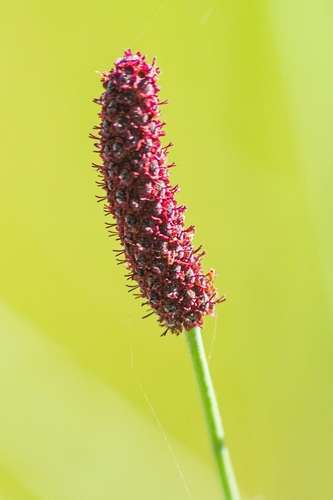
Eryngium ebracteatum Lam. is an evergreen herbaceous perennial that reaches 1.5 meters in height. It has grey-green lance-shaped leaves that are almost or completely spineless, unlike other South American Eryngium species. Its deep-red cone-shaped inflorescences grow on wiry branching stems. Due to the absence of bracts and their reddish color, these inflorescences are often mistaken for species in the Sanguisorba L. genus, specifically S. tenuifolia Fisch. ex Link. and S. officinalis L. This species has underground storage organs and long, minimally branched taproots. Its glaucous leaf color comes from a coating of epicuticular waxes; the specific arrangement of these wax crystals makes the leaves ultrahydrophobic. This adaptation, called the lotus effect, is thought to help remove dust and soil particles from the leaf surface, which may carry pathogens or reduce photosynthetic activity. Eryngium ebracteatum is widely distributed across South and Central America, and has been recorded in Brazil, Costa Rica, Paraguay, Uruguay and Venezuela. It is native to undegraded regularly flooding pampas and humid mesophytic meadows, growing at elevations between 130 and 1600 meters. The most commonly cultivated Eryngium species belong to subgenus Eryngium, which are native to rocky and coastal habitats. New World grassland Eryngium species are cultivated less often, but are growing in popularity for their compatibility with the naturalistic planting movement. In cultivation, Eryngium ebracteatum needs full sun and moderately fertile soil. Although it originates from wetland habitats, it is susceptible to root and crown rot when exposed to both low temperatures and waterlogged soil. Most cultivated Eryngium ebracteatum specimens belong to the variety 'poterioides'.