About Eryngium creticum Lam.
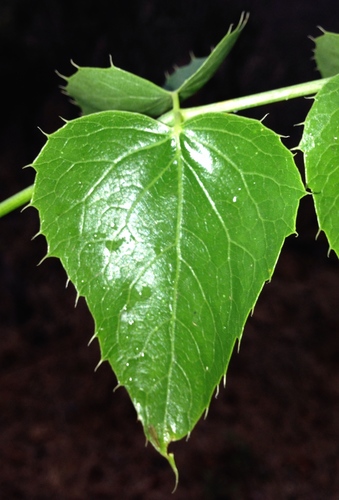
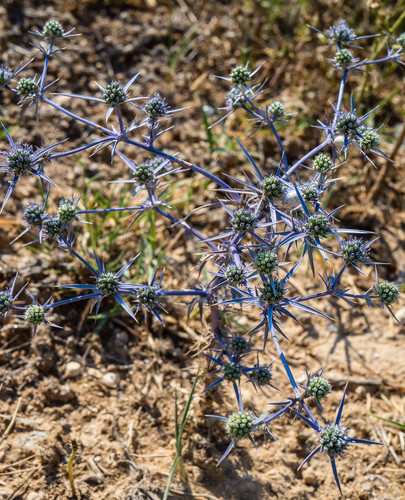
This species of eryngo, Eryngium creticum Lam., produces a widely spreading, diffuse arrangement of blue flowers on slender blue branches. The lowermost leaves grow in a spreading circular pattern; these leaves are fairly simple, with 0 to 2 smaller lobes, and wither by the time the plant flowers. Leaves growing higher on the plant have a different structure, with more complex, somewhat broad, toothed lobing. This species can easily be confused with several other similar eryngo species. Each of its flower heads is surrounded by 5 or occasionally 6 slender spine-like leaves, and each small flower inside the head has a three-part spine. Its inflorescence stems are not channeled, and each flower head contains numerous individual flowers. It naturally grows at field edges, path edges, on rocky ground, in waste places, and similar open habitats. It is native to the northern and eastern Mediterranean region, ranging eastwards to Iran, and has been naturalized in additional countries. Its confirmed native range includes Albania, Bulgaria, Cyprus, the East Aegean Islands, Egypt, Greece, Iran, Iraq, Italy, Crete (Kriti), Lebanon-Syria, the northwestern Balkan Peninsula, Palestine, Sinai, Türkiye, and the European portion of Türkiye. It has been introduced into France. This plant has medicinal uses. Its stems are used to prepare an anti-tussive tea, which is also used to treat kidney inflammation. In Jordan, it is used as a remedy for scorpion stings, and it is also used to treat hypoglycemia.