About Eryngium campestre L.
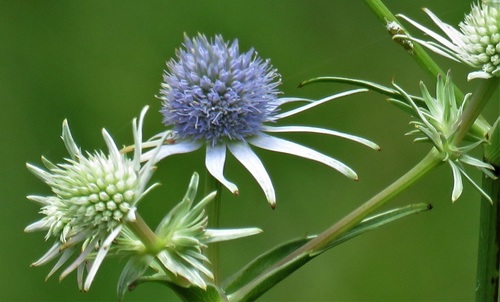
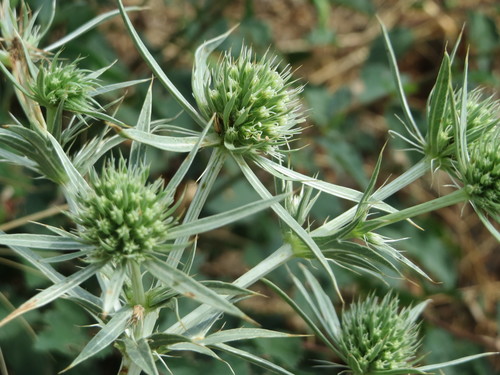
Eryngium campestre L. is a stiff, hairless perennial that appears greyish or greenish. It has complexly divided prickly leaves, and produces many small greenish flower heads. Each flower head is subtended by a whorl of 5-6 large spine-like bracts, and every small individual flower within the head is accompanied by a small simple spine. The basal leaves are long-stalked and pinnate. There are two recognized natural varieties of this species. Variety campestre is a blueish-greyish green, and its subtending whorled bracts are widest near their middle. It occurs mostly in more northern regions, ranging north of the Mediterranean from Portugal to Germany in the west, eastwards through Turkey to Central European Russia; it also reaches south into North Africa, present only in Algeria and Morocco. Variety virens (Link) Weins is a yellower green, with its subtending whorled bracts widest near their base. It is more xerophytic (dry-tolerant), and occurs mostly in more southern and eastern regions, ranging along the southern side of the Mediterranean from Morocco to Iran, with a patchy distribution directly to the north of this range. In Britain, this species resembles the better-known sea holly (Eryngium maritimum), but is taller and looser, a deeper green, its whorls under the flower heads are not leaf-like, and its flower heads are smaller. It also resembles some garden Eryngos, but is green. Eryngium campestre flowers between July and September. Within its range, it is common across many areas, but in Germany it is restricted to dry habitats near the Rivers Rhine and Elbe. In the British Isles, it is very uncommon, growing in dry grassland on neutral or calcareous soils in the southeast. It was first recorded in 1662 by naturalist John Ray in Devon. It has statutory protection in Somerset and Devon, where it persists in several sites. Elsewhere in the British Isles, it is mostly a short-lived casual found on waste ground, road verges and rough pastures. In herbalism, an infusion of this plant is used to treat coughs, whooping cough and urinary infections. Its roots were formerly candied as sweets, or boiled and roasted as a vegetable. The plant’s active constituents are essential oils, saponins, and tannins. In Iran’s Mazandaran Province, it has been used in various local dishes for centuries.