About Eryngium alpinum L.
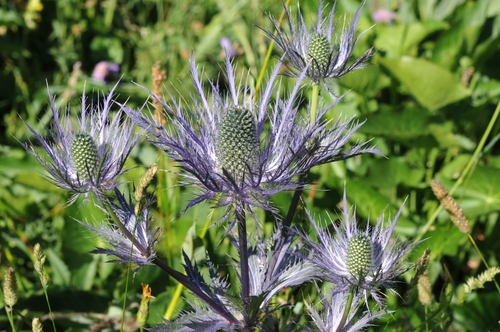
Eryngium alpinum L. is a hemicryptophyte, with overwintering buds located just below the soil surface and a more or less erect floral axis that bears a small number of leaves. It has deep, robust roots. Its stems grow as a single erect structure, usually with three branches at the apex, and are marked with longitudinal purple stripes. This species typically grows to 30–70 centimetres (12–28 inches) in height, and can reach a maximum height of 100 centimetres (39 inches). The basal leaves are oval or heart-shaped, measuring 10–15 centimetres (3.9–5.9 inches) wide and 13–17 centimetres (5.1–6.7 inches) long, with toothed margins and a long petiole. Cauline leaves are sessile, and become progressively more divided moving up the stem. The inflorescences are dense umbels that grow at the top of the main branches. The bases of these umbels are bright green, and their stiff, bristly bracts are blue. The umbels themselves are approximately 4 cm long and 2 cm in diameter, while the bracts can grow up to 25 centimetres (9.8 inches) long. The individual flowers inside the umbels are about 2 mm long. Peripheral flowers are sterile, while internal flowers are hermaphroditic. Both flower types are actinomorphic and pentamerous, with five petals each. Flowering takes place from July through September, and flowers are pollinated by insects. The fruit is a spiny achene about half a centimeter wide. This species is native to Austria, Liechtenstein, Croatia, France, Switzerland, Italy, and Slovenia. It grows in subalpine scrub, rocky areas, and wet pastures, and prefers limestone substrates. It occurs at altitudes between 1,500 and 2,000 metres (4,900–6,600 feet) above sea level. Eryngium alpinum is cultivated as an ornamental plant, valued for its blue and purple flowerheads. For cultivation, it requires dry, well-drained soil and full sun exposure.