About Erithacus akahige (Temminck, 1835)
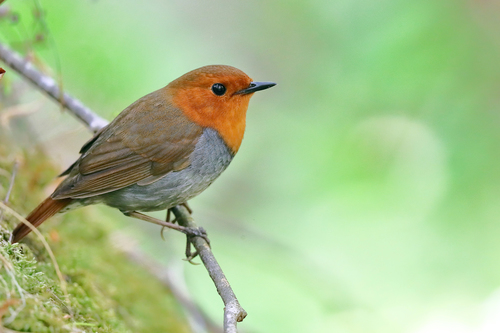
The Japanese robin, scientifically named Erithacus akahige, has a body length of 14 to 15 centimeters. Its plumage is mainly gray and bright orange. Males have olive-brown plumage from the top of the head to the rump, orange on the face and neck, and gray on the breast and underside. Males also have a reddish-brown tail, pinkish-brown legs, and a black bill. Females look very similar to males, but their orange and brown coloration is much duller and covers less area. Juveniles also resemble adults, but have dark spotting on the breast, pale rufous feathers from the crown to the mantle, and rufous buff. Japanese robins inhabit natural environments including islands, lakes, mountains, and temperate forests. Their habitats provide plenty of the small insects and plants that this species eats. They specifically occupy damp, dense, shady areas such as the undergrowth along valleys and streams. Most Japanese robins reside in broadleaf and deciduous forests across the Japanese islands of Honshu, Shikoku, Hokkaido, Sakhalin, and Yakushima, and migrate to Southeast Asia for winter. Japanese robins breed during May and June in central Japan. Their nests are typically built from moss, twigs, dry leaves, ferns, and roots. When ready to breed, females lay 3 to 5 greenish eggs at a rate of one egg per day, then incubate the eggs for approximately two weeks. After hatching, young chicks are cared for for 31 days (one month), before they leave the nest to become independent. Japanese robins do not mate for life, and only seek out a partner during the spring mating season.