About Eriovixia excelsa (Simon, 1889)
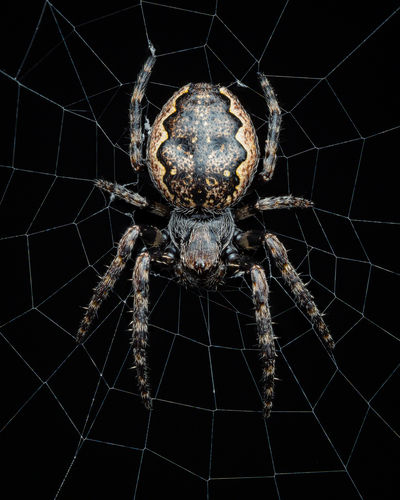
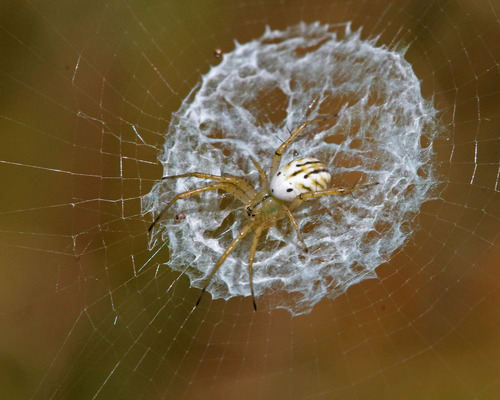
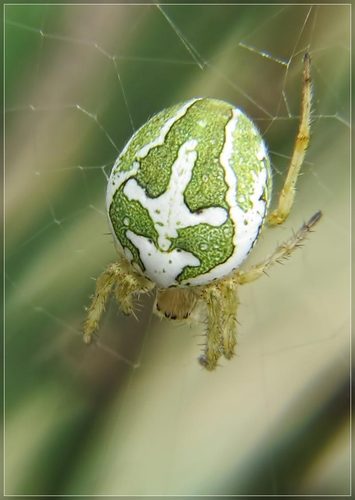
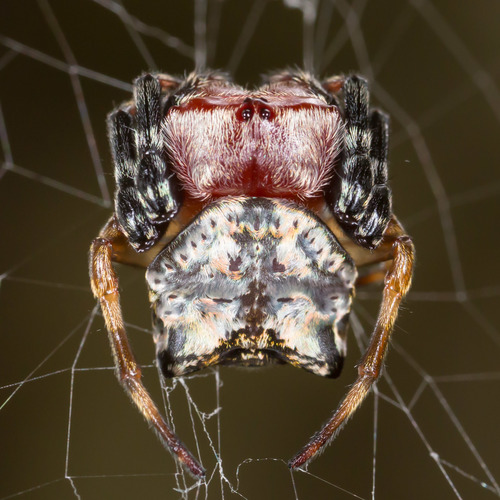
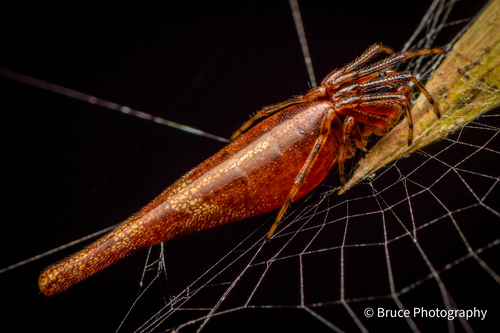
Eriovixia excelsa (Simon, 1889) is a small orb-weaver spider. Females have a total body length of approximately 5.5 mm, while males measure around 3.7 mm, so females are typically larger than males. For all Eriovixia species including this one, the prosoma is covered in long soft hairs, the opisthosoma is nearly triangular and tapers toward the posterior end, and legs are spiny. In female E. excelsa, the epigynum has a short scape fused to curved sclerites that hold two copulatory openings. The abdomen of this species has a characteristic tubercle at its posterior end. This spider has been naturally recorded in Pakistan, India, Thailand, China, Taiwan, the Philippines, and Indonesia. It has been introduced to South Africa and Eswatini, where it may be considered invasive. In South Africa, it has been recorded in four provinces at altitudes ranging from 148 to 1,444 m above sea level. All Eriovixia species are nocturnal: they dismantle their webs in the morning and rebuild new webs each night. They have poor vision, especially in daylight, and rely mostly on mechanoreception. The hairs on their prosoma act like whiskers, making them quite sensitive to air currents. E. excelsa inhabits Grassland and Savanna biomes. It builds orb webs between vegetation, and these webs usually have a very long bridge line. One notable ecological observation documented a mimetic relationship between E. excelsa and the beetle Cassida calvaria at Palmiet Nature Reserve near Durban: the two species share similar size, colouring, and body patterns. Eriovixia species act as important biological controls for pest populations, including agricultural pests and pests that carry human diseases. Specifically, E. excelsa controls crop-damaging flies in citrus agroecosystems. Research has found that silk from Eriovixia species has potential antibacterial properties, and this silk can be used to produce antibiotics active against Streptococcus sp., Pasteurella sp., and Staphylococcus sp.