About Eriostemon australasius Sm. ex Steud.
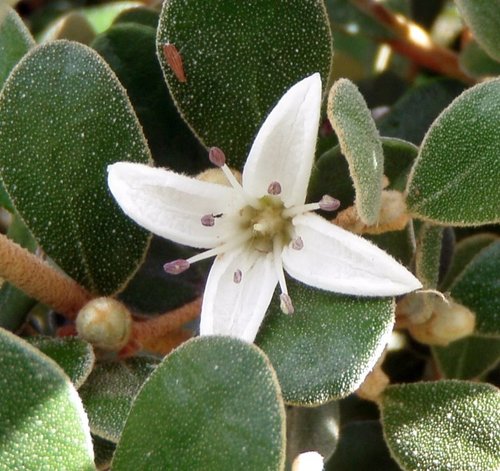
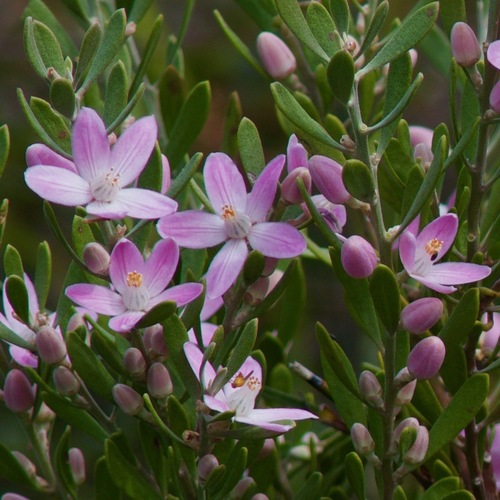
Eriostemon australasius is an erect, bushy shrub that reaches a height of 1 to 2 metres (3 to 7 feet). It bears simple, narrow oblong leaves that are 20 to 80 millimetres (0.8 to 3 inches) long and 8 to 14 millimetres (0.3 to 0.6 inches) wide. Young leaves are covered in tiny star-shaped hairs that are often only visible when viewed through a magnifying glass. Flowers grow singly in leaf axils, mostly near branch ends, on a stalk 4 to 12 millimetres (0.2 to 0.5 inches) long. Five to twelve sepal-like bracteoles are located at the base of each flower. This species has five pink to reddish petals around 18 millimetres (0.7 inches) long; petals are covered in the same type of star-like hairs found on young leaves, and become smooth as they mature. Flowering takes place in late winter and early spring.
Commonly called pink wax flower, Eriostemon australasius grows in heathland and dry eucalyptus woodlands. Its natural range extends from Lake Conjola on the New South Wales south coast northwards along the coast to Fraser Island in Queensland.
Eriostemon australasius was first cultivated in England in 1824. It adapts reasonably easily to garden cultivation when provided with good drainage, and grows well in conditions ranging from dappled shade to full sun. The plant's roots benefit from some shelter. It can be propagated from cuttings, or from seed, though propagation from seed is difficult. This species is moderately frost tolerant.