About Eriopis connexa (Germar, 1824)
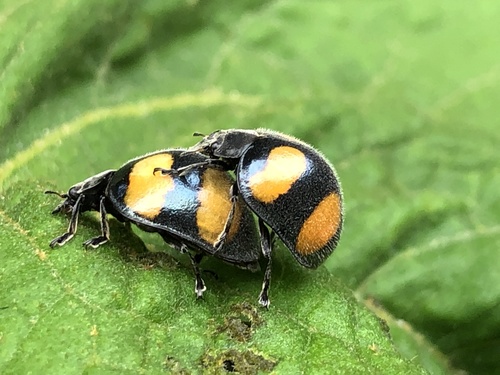
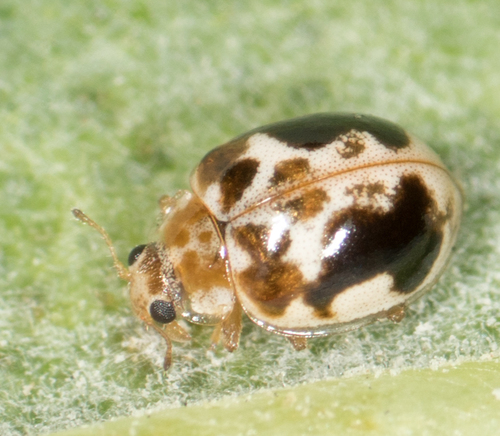
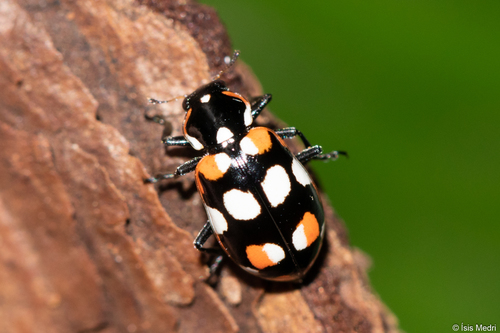
Eriopis connexa (Germar, 1824) has an oblong body shape. Its base body color ranges from dark brown to black, marked by relatively large, separated yellowish dots. Both the pronotum and elytra (wing covers) have a yellowish margin. Each elytron holds three separate yellowish dots, plus enlarged margin sections; the pronotum holds two smaller yellowish dots, plus two enlarged margin sections. Visible sexual dimorphism is not always present in this species, but during certain periods of adulthood, females develop extended abdomens for egg production. Adult females can also be distinguished from adult males by their significantly heavier body weight. Eriopis connexa is a Neotropical species native to South America, and has been introduced to the United States for biological pest management. It has been recorded in multiple South American regions: Argentina (Buenos Aires, Catamarca, Córdoba, Chaco, Chubut, Entre Ríos, Formosa, La Rioja, Mendoza, Misiones, Neuquén, Río Negro, Salta, San Juan, Santa Fe, Santiago del Estero, Tucumán), Bolivia (Cochabamba, La Paz, Oruro), Brazil (Mato Grosso, Minas Gerais, Paraná, Pernambuco, Rio Grande do Sul, Santa Catarina, São Paulo), Ecuador (Guayas), Paraguay (Alto Paraná, Caazapá, Central, Kanindeyu, Paraguarí, Pte. Hayes, San Pedro), Peru (Apurimac, Arequipa, Ayacucho, Cusco, Lima), Uruguay (Florida, Maldonado, Montevideo, San José), and Venezuela. This species occurs across a wide variety of agroecosystems, including those with cotton, maize, sorghum, pine, citrus, soybean, and wheat plants. Studies investigating E. connexa’s pest management potential have found this predatory beetle effectively controls aphid populations on cabbage and greenhouse strawberry plants, indicating the species has a broader potential habitat range than originally understood. Eriopis connexa has five main sequential developmental stages: egg, larva, pre-pupa, pupa, and adult. The larval stage is further divided into four instars. Laboratory studies show individuals spend approximately two days in each of the first three instars, nearly four days in the fourth instar, one day in the pre-pupa stage, and three to four days in the pupa stage; the remainder of their lifespan is spent as adults. The duration of each developmental stage can vary based on the prey available to E. connexa. Total lifespan is typically around 60 days. Both males and females reach full sexual maturity on the fifth day of the adult stage. Individuals of both sexes become sexually receptive on the third day of adulthood, but have not yet reached maximum fertility and fecundity, which may be caused by incomplete maturation of sexual organs. Because Eriopis connexa is a voracious predator of aphids (a highly destructive agricultural pest), and occurs naturally in economically important crops, this predatory beetle is frequently used for biological pest control. It was first introduced to the United States to control populations of the Russian wheat aphid (Diuraphasis norxia). As many agricultural pests continue to evolve insecticide resistance, alternative pest control methods have become more desirable and necessary. Evidence indicates that in South America, Eriopis connexa has potential to act as a natural predator of corn and sorghum pests.