About Eriophorum viridicarinatum (Engelm.) Fernald
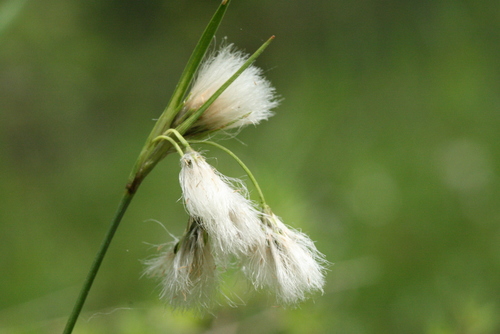
Eriophorum viridicarinatum (Engelm.) Fernald is a perennial sedge that grows from a rhizome. It forms tufts of stiff, erect stems, and may sometimes produce just a single stem. Its basal leaves can grow up to 30 centimeters long. The inflorescence is accompanied by two to four leaflike bracts, each a few centimeters long. This species can produce up to 30 spikelets, which increase in size as the fruit develops, eventually reaching 3 centimeters in length. Each flower bears a tuft of long, cottony white or brown bristles that measure up to 2.5 centimeters long.
Eriophorum viridicarinatum is native to northern North America. It occurs in Alaska, across much of Canada, and its range extends into the northern contiguous United States. It is widespread in eastern Canada, and has a spotty distribution in western Canada and Alaska. Within the United States, it is most common in western Montana, the Great Lakes region, and New England.
This is an obligate wetland (OBL) species. Across its entire range, it grows in marshes, wet meadows, bogs, fens, and wet woodlands, at altitudes up to 2,000 meters (6,600 feet). In the Pacific Northwest, British Columbia, Montana, and Wyoming, it typically grows in montane and alpine zones. In New England, it prefers fens and high-pH meadows. It is a strict calciphile in Michigan, Pennsylvania, and Vermont, and its range of suitable habitats broadens further north into Canada.