About Eriogonum niveum Douglas ex Benth.
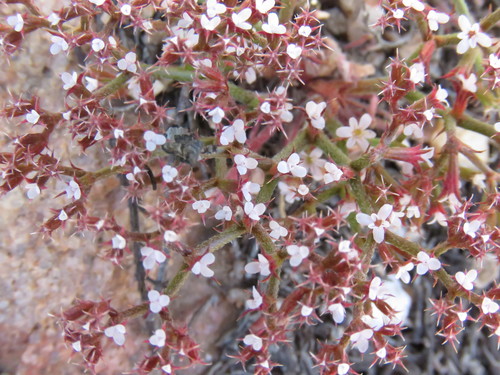
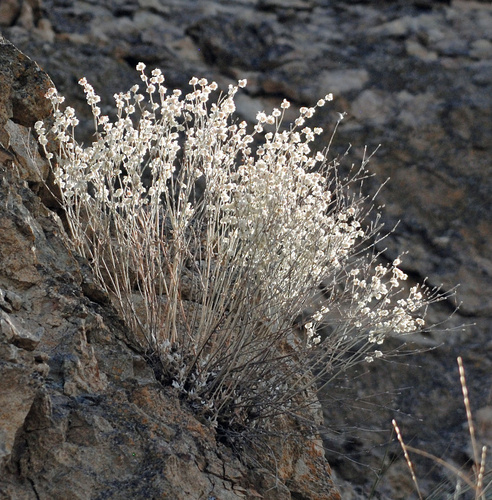
This wild buckwheat, scientifically named Eriogonum niveum Douglas ex Benth., varies quite a bit in appearance. It has spreading stems that usually grow erect, but they may also grow decumbent or prostrate along the ground. The plant forms a hairy mat, generally reaching 40 to 60 centimeters (16 to 24 inches) in both height and width, though it can sometimes grow up to one meter tall and wide. Most of its leaves grow in a tuft on the plant's woody base; leaves are up to 6 centimeters long and have a woolly texture. Its inflorescence is made up of a series of branching stems holding sparse clumps of small white, pink, or reddish flowers. Native American groups had several medicinal uses for this plant: it was used as a remedy for colds and cuts. The roots of this plant and Eriogonum heracleoides were brewed into a tea to treat diarrhea. This plant grows on grassy plains, in sagebrush deserts, and in ponderosa pine forests, mainly east of the Cascade Range. It is a pioneer species that establishes in thin, dry soils where other plants have not yet grown. Common plants that grow alongside it in its habitat include Artemisia tridentata, Purshia tridentata, Juniperus occidentalis, Pseudoroegneria spicata, Spobolus airoides, Elymus wawawaiensis, Poa secunda, Achnatherum hymenoides, and Nassella comata. Eriogonum niveum can be cultivated. It can be planted in areas with very little soil, such as mine spoils, and it is suitable for use in xeriscaping. The cultivar 'Umatilla' is used for rangeland restoration and soil stabilization. In the wild, this plant provides food for mule deer and bighorn sheep, and it is also used by the rare Mormon metalmark butterfly.