About Eriogonum gypsophilum Wooton & Standl.
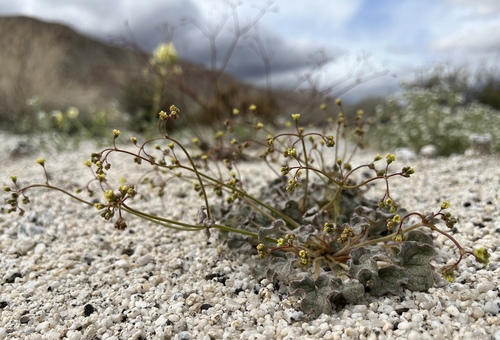
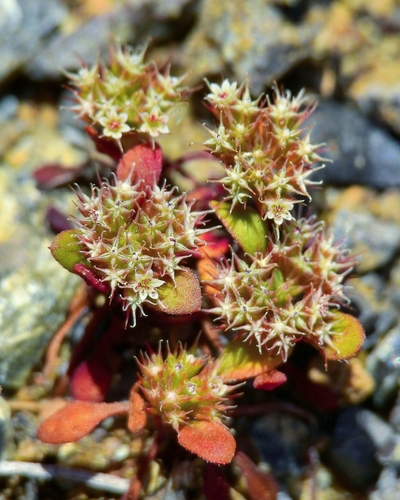
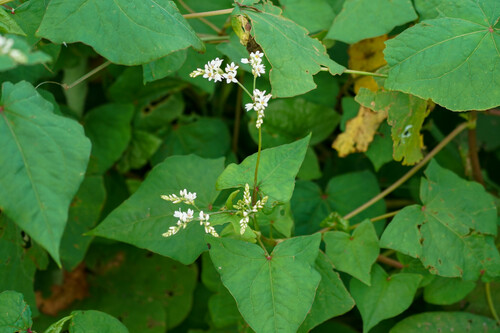
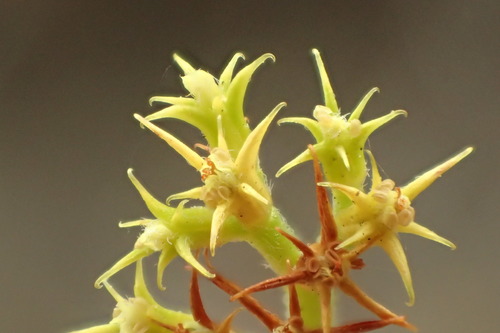
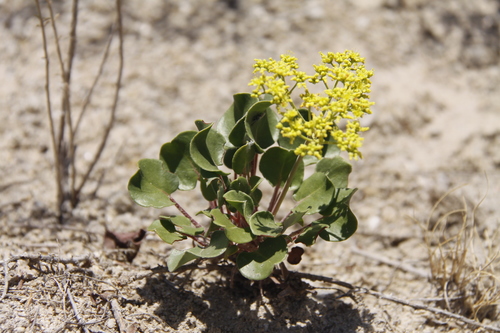
Eriogonum gypsophilum Wooton & Standl. is a perennial wild buckwheat. It generally reproduces vegetatively by growing new stems from its rhizome, creating genetic clones of itself. It sometimes produces seed for sexual reproduction, but the habitat and climate of its native range are often unsuitable for seed germination. Because many individuals are clones rather than distinct genetic plants, it is hard to accurately count the true number of individual plants. Current estimates place the total number of counted plants between 11,000 and 18,000 in each of this species' three known populations. It is possible that additional unrecorded populations grow in unsurveyed gypsum rock habitat across the Eddy County border in Texas, but most of this habitat is located on private land and not accessible for survey work. This species grows erect stems that reach up to 20 centimeters tall. The stems bear inflorescences made of many small bright yellow flowers, arranged in headlike clusters or cymes. The base of the plant is surrounded by a mat of green leaves that grows on the plant's branching caudex. This rare plant is only known from three locations in Eddy County, New Mexico: the Seven River Hills, the Black River, and Ben Slaughter Draw, a small sloping valley. It grows exclusively on gypsum substrates, including gypsum rock outcrops and areas with gypsum soil. Its native habitat is barren and rocky, with very few other plant species growing there besides other gypsum-tolerant gypsophile species. Associated plants that grow alongside this buckwheat on its nearly pure gypsum substrate include Tiquilia hispidissima, Mentzelia humilis, and Anulocaulis leiosolenus. This species' native range falls within the Chihuahuan Desert, and the surrounding surrounding habitat is creosote scrub.