About Eriogonum giganteum S.Watson
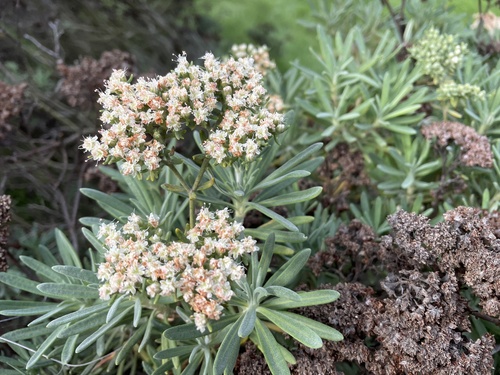
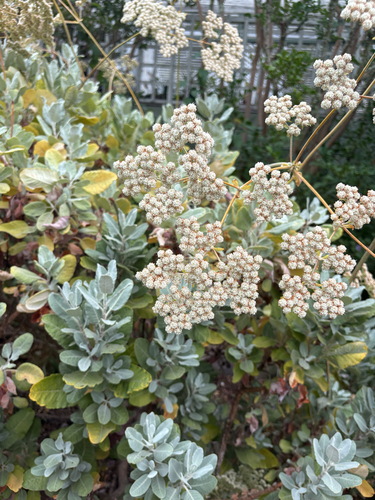
Eriogonum giganteum S.Watson is an evergreen shrub that varies greatly in size. It can grow as small as 0.5 metres (1.6 ft) in both height and width, or develop into a sprawling or rounded bush reaching over 3 metres (9.8 ft) high and wide. Its leathery, woolly, oval-shaped gray leaves cluster sparsely along mostly bare branches. Flowering inflorescences rise prominently above the foliage on strong stalks, forming broad, domed blooms densely covered in carpets of clustered tiny white flowers that fade to rust red. Each individual hairy flower is only a few millimeters across. This shrub is endemic to the Channel Islands of California, where it grows in the coastal sage scrub plant association habitat of the Coastal sage and chaparral sub-ecoregion. One variety of this geographically restricted species, Eriogonum giganteum var. compactum (the Santa Barbara Island buckwheat), is endemic only to Santa Barbara Island and is particularly rare there. Eriogonum giganteum is cultivated as an ornamental plant. It is used in native plant gardens, drought-tolerant gardens, wildlife gardens, and natural landscaping projects. Its coarser texture and semi-open growth form make it a good background plant for gardens. It is a honey plant that supports a high diversity and large number of pollinators while blooming. Like most native California buckwheats, it especially supports pollinator insect species native to California, and is a very important nectar source for butterflies. Many smaller animals use its flowers, leaves, and seeds.