About Eriogonum flavum Nutt.
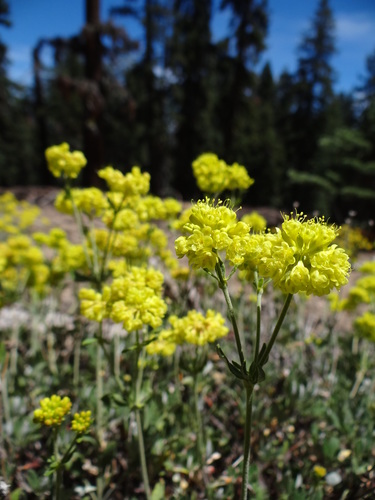
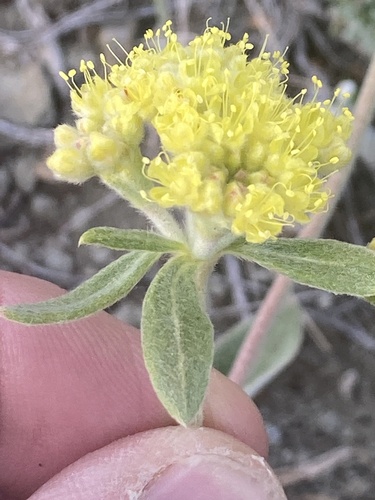
Eriogonum flavum Nutt. is a perennial herb that grows from a taproot and woody caudex, forming dense mats over small areas. Its leafless flowering stems reach approximately 5–20 cm in height. The dark green leaves are 2.5–7 cm long, spatulate-oblanceolate, and borne on long petioles; the upper leaf surface is greenish, while the lower surface is heavily covered in whitish tomentose hairs. As a perennial that re-grows each year from its persistent taproot and woody caudex, this species is likely long-lived. It flowers from late May to mid-July. Its inflorescence is a dense umbel (an umbrella-shaped cluster of flowers), with leaf-like bracts at its base. Each ray of the umbel holds one heavily villous involucre, roughly 5–6 mm high. The perianth is 4–6 mm long, very hairy, and typically pale yellow. This species produces an aroma that is unpleasant to humans but attractive to pollinating bees. Around half of the viable population produces flowers in any given season, and seeds are uncommon, which further supports the observation that this plant is long-lived. Primary seed dispersal occurs via downhill transport, while wind likely aids in uphill seed dispersal. Downhill growth of caudex branches supports vegetative dispersal. Fruits are 3–5 mm long, three-angled achenes that are sparsely pubescent at the tip. More detailed morphological traits are as follows: inflorescences are subcapitate or umbellate, measuring 0.5-3(-5) × 0.3-2.5(-3) dm; branches are tomentose to floccose; 4-6 leaflike to semileaflike bracts are present at the proximal node, measuring 0.5-2 × 0.2-0.5 cm, and are sometimes absent immediately below the involucre. Involucres occur 1 per node, are turbinate to campanulate, measure 3-9 × 2-5 mm, and are tomentose to floccose; they have 5-8 erect teeth, 0.2-1 mm long. Flowers measure 3-7 mm, including a 0.2-1.5 mm stipelike base; the perianth is pale to bright yellow, densely pubescent on its abaxial surface; tepals are monomorphic and oblong; stamens are exserted, 3-6 mm long; filaments are pilose proximally. Achenes are light brown to brown, 3-5 mm long, and glabrous except for the sparsely pubescent beak. This plant generally grows at moderate to high elevation, in rocky open soils on ridges or in grasslands. It occurs at 1,000 m in the Yukon, and as low as 170 m in Alaska; the average elevation across the southern portion of its range is around 2133.6 m. It is associated with rock, scree, gravel, silt, and loamy substrates, and usually grows on south-facing slopes between 20° and 50°. This species has an extensive range covering most of the Pacific Northwest. It is found north to British Columbia, south to the Blue Mountains of Oregon and California, and east to south central Idaho, Colorado, and southwestern Alberta. The subspecies Eriogonum flavum subsp. aquilinum ranges north to eastern Alaska, and occurs throughout British Columbia and the Yukon. This plant is used as browse by many animal species: deer, elk, horses, bighorn sheep, and mountain goats browse its umbels, while blue grouse consume its leaves, along with associated insects. Plains Native American tribes used mashed roots of this plant as ear plugs, and added its flowers to the process of tanning buffalo hides. Children ate the plant's roots as a sweet snack. Noted wildflower author Claude A. Barr regarded this species, also called yellow umbrella plant, as an outstanding garden flower, valued for its green velvety leaves and sulfur yellow flowers. Although it grows in stony, barren soils in the wild, it grows successfully in ordinary somewhat alkaline garden soils, or even soils with high clay content. It can be propagated by seed, but its crown and thick taproot cannot be divided.