About Eriogonum cinereum Benth.
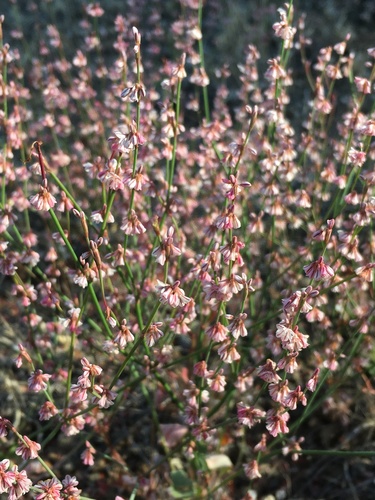
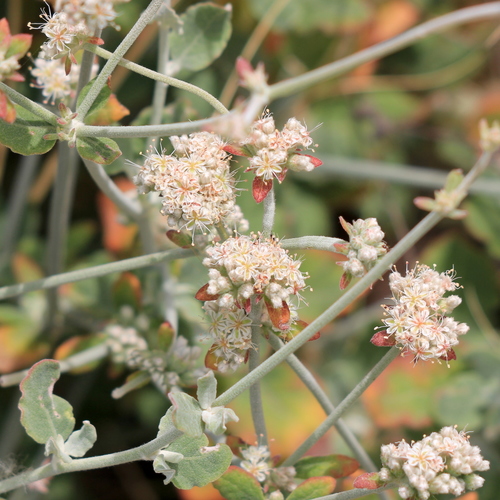
Eriogonum cinereum Benth. typically grows 2 to 4 feet (0.61 to 1.22 meters) tall and wide. Its stems and foliage are covered in woolly hairs, giving the entire plant a light silvery gray color. Its leaves are oval with wavy edges, and measure 1 to 3 centimeters long. Inflorescences extend outward from the plant; each holds one to several clusters of tiny, tightly packed, frilly flowers. These flowers are usually colored light whitish-pink to brownish-pink, and are quite hairy. This shrub is endemic to the coastline of Southern California, found mainly in Los Angeles County and Ventura County. It grows on beaches in coastal strand habitats, and on bluffs and lower slopes of the Western Transverse Ranges (including the Santa Monica Mountains), in chaparral and coastal sage scrub habitats below 400 meters (1,300 feet). It serves as a food plant for Euphilotes bernardino, the Bernardino dotted blue butterfly. Buckwheats of the Eriogonum genus are very important resources for a variety of butterflies and native wasps. Eriogonum cinereum is cultivated as an ornamental plant. It is used in native plant gardens, drought-tolerant gardens, butterfly gardens, other types of wildlife gardens, larger designed natural landscaping projects, and habitat restoration projects.