About Eriocaulon scariosum Sm.
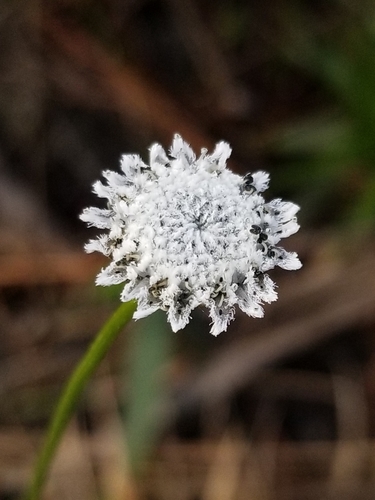
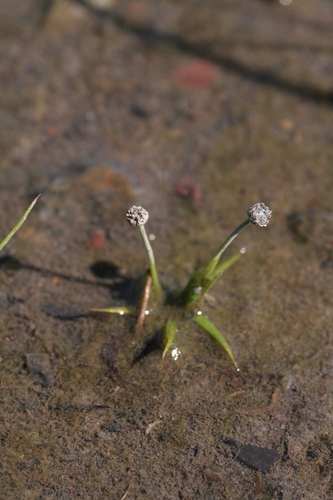
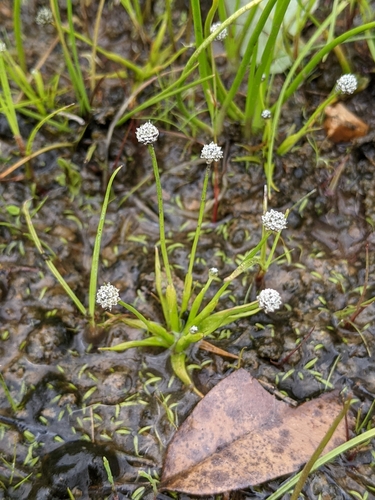
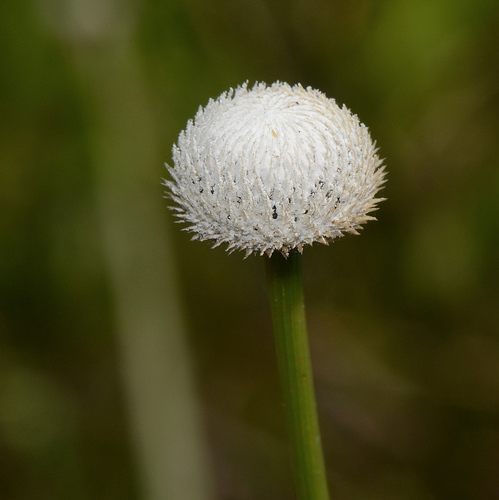
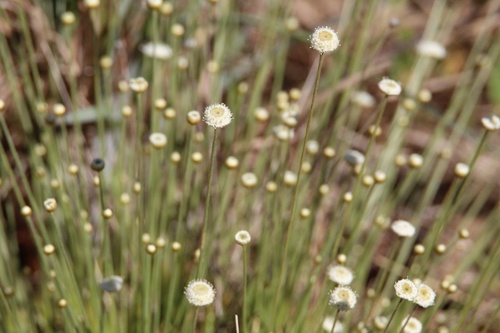
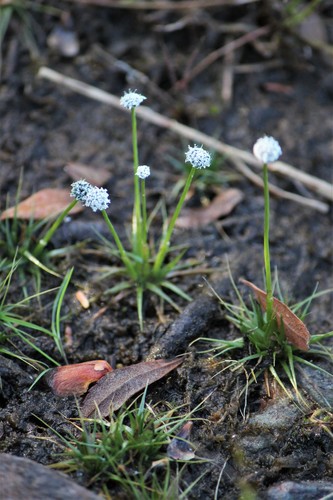
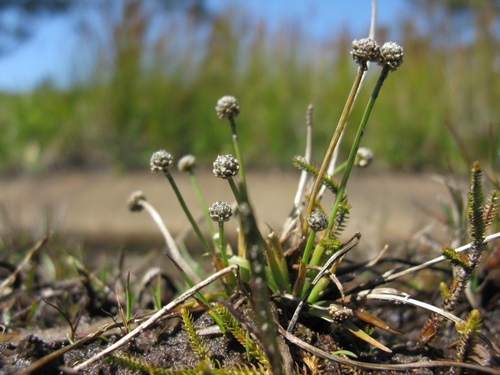
Eriocaulon scariosum Sm. is an aquatic monocot belonging to the Eriocaulaceae plant family. It is native to Australia, and found across Victoria, New South Wales, Queensland and the Northern Territory, most commonly in eastern and central Victoria, New South Wales, Queensland and the Northern Territory. It is a small plant with small, thin, flat leaves and a thin, long stem. The plant produces new leaves outwards from its central crown. It has terminal buds, and tiny flowers that are bunched together into a ball-like shape, with fringed bracts at the base of the flower cluster. In New South Wales, its flowering period runs from January to June. When in flower, leaves of Eriocaulon scariosum measure 15 to 80 mm long and 1.5 to 2 mm wide. Its bracts have concave, scarious, glabrous inner surfaces, and glabrous outer surfaces; inner bracts are obovate to spathulate, greyish, and concave, while short white hairs cover the distal abaxial outer surface. Flower heads of this species measure 3 to 6 mm long, and 3.5 to 5.5 mm wide. Involucral bracts are straw-yellow, egg-shaped, and range from elliptic to broadly elliptic, measuring 1.75 to 2 mm long and 0.9 to 1.5 mm wide. They are obtuse, and reflexed at maturity. Floral bracts are 1.5 to 2.5 mm long, 0.6 to 1.1 mm wide, and are either translucent to black, or have a translucent base. Thinly distributed white hairs are present at the apex of the plant. Flower clusters of Eriocaulon scariosum may contain a mix of male and female flowers, or be predominantly male or predominantly female. Male flowers are stipitate, with 3 outer tepals, one of which is linear. Female flowers have 2 or 3 irregular outer tepals; one tepal is either absent or linear, while the others are oblong-spathulate and dark brown to black. Female inner tepals are 3 in number, narrow-oblong to spathulate, white, and have short hairs on their surfaces. Biologists use key features to differentiate Eriocaulon scariosum from other Australian Eriocaulon species: the plant’s seed epidermal cells are approximately isodiametric (with nearly equal diameters), seeds measure 0.4 to 0.53 mm long and 0.3 to 0.38 mm wide, and seeds have peg-like projections on their longitudinal and transverse walls. Additional distinguishing features include a level, smooth flowerhead outline, involucral bracts positioned below or close to the flowers, male sepals formed into a terminal spathe, and dimorphic female sepals with two different forms of laterals. This species is noted as rare in Victoria by The Royal Botanic Gardens Victoria, and is categorised as "rare" in the 2014 Advisory List of rare or threatened plants in Victoria, maintained by the Victoria Department of Environment and Primary Industries, which draws on technical scientific information and input from a range of botanic experts. Across the rest of Australia, it is widespread and not considered under threat. It is not listed under the federal Environment Protection Biodiversity Conservation Act 1999, and is classified as Least Concern under the Queensland Nature Conservation Act. Eriocaulon scariosum grows in wet, sandy-soil areas including wetlands, bogs, melaleuca swamps, lakes, springs, and drainage areas. Due to its small size, it is often overlooked and inconspicuous in these damp habitats. It occurs in the Castlereagh Swamp Woodland Community, an endangered ecological community that hosts several regionally important plant species, as noted in the 1997 Urban Bushland Biodiversity Survey conducted by NPWS. This species forms part of a Queensland species complex of related Eriocaulon that also includes Eriocaulon odontospermum and Eriocaulon annum. It has been recorded at three Fraser Coast localities: Tuan Forest, Talegalla Weir, and Fraser Island, and is also recorded in the Wilde Bay district in the Queensland Herbarium Census. The broader Eriocaulaceae family grows best in the Western Hemisphere, specifically New World tropics, with centres of diversity for the Eriocaulon genus located in Africa, the Indian subcontinent, and South America. Most species in the Eriocaulon genus are small perennial herbs that grow in shallow water or damp habitats. For Eriocaulon plants, nectar produced by glands at the tips of petals attracts insects for pollination. In wet habitats, the abundance of Eriocaulon scariosum is shaped by fire frequency, water levels, and competition from other plants such as grasses. Studies have found this species has lower survival rates compared to other wetland plant species. As threats and growing requirements for Eriocaulon species have become better understood, the genus has become more commonly cultivated. To grow well, Eriocaulon species require a soft water substrate with available carbon dioxide; they grow much better with higher CO₂ levels and increased light. Poor growth is indicated by a weak root system and faster aging of older leaves. Healthy, strong growth produces stiff leaves (rather than soft) arranged in a neat, non-messy, non-indented pattern. Most Eriocaulon species naturally produce offshoots as they grow larger. Offshoots can also form when the plant experiences instability or stress, such as relocation or a change in growth conditions. When multiple offshoots grow at the same time, the entire plant cluster will deteriorate.