About Erigeron poliospermus A.Gray
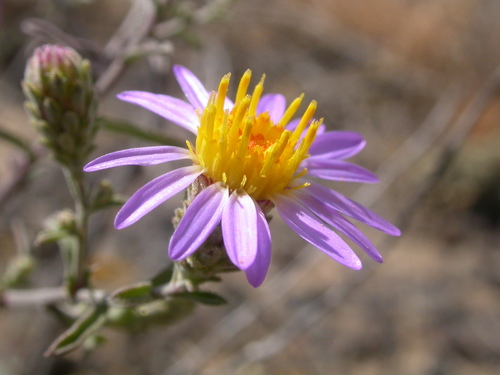
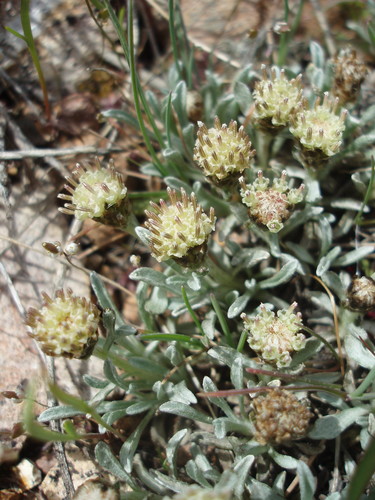
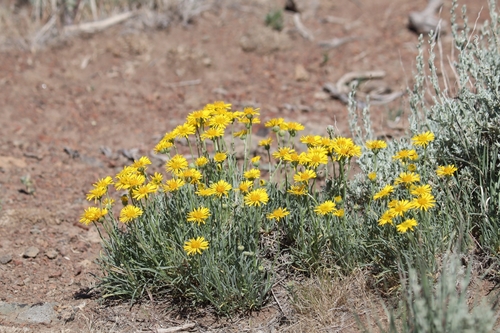
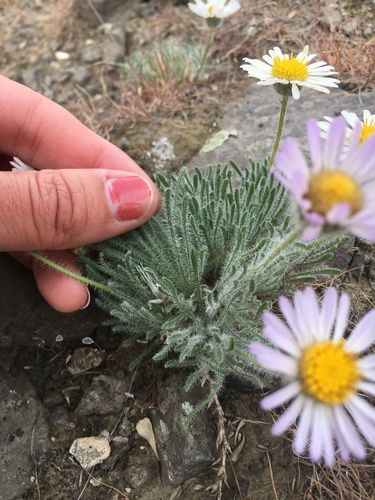
Erigeron poliospermus is a small perennial herb that rarely grows over 15 centimetres (5+7⁄8 inches) tall, and forms a woody taproot. Its leaves grow from the plant's base, have a shape ranging from linear-oblanceolate to spatulate, are up to 8 cm long and 12 mm wide, and are covered in long protruding hairs. Each stem grows from the base of the plant, is covered in hairs, is leafless or may carry a few very small reduced leaves, and most often bears a single flower head (rarely up to 3 heads per stem). Each flower head holds 15–45 pink, purple, or white ray florets that surround numerous yellow disc florets. Ray florets are entirely absent in E. poliospermus var. disciformis. The involucre bracts measure 5–9 mm (1⁄4–3⁄8 inches) in length, are roughly all the same length, and have a sparse to dense covering of white hairs. Seeds develop inside achenes that are densely covered in long silky hairs, and are thought to be dispersed by wind. The related species Erigeron pumilus shares a similar appearance, but it is typically taller, generally shaggier, has much more prominent leaf-like bracts scattered along its branched flower stem, usually produces multiple flowers per stem, and has narrower basal leaves. Erigeron poliospermus grows in desert, scrub, and rocky habitats at elevations below 1,800 metres (6,000 feet), and is occasionally found at higher elevations. It is common on the Columbia Plateau, growing in thin rocky soils overlying basalt bedrock. The recognized varieties of this species, with their distributions, are: Erigeron poliospermus var. cereus Cronquist, found in Washington; Erigeron poliospermus var. disciformis (Cronquist) G.L.Nesom, found in Washington and Oregon; and Erigeron poliospermus var. poliospermus, found in British Columbia, Washington, Idaho, and Oregon.