About Erigeron annuus (L.) Pers.
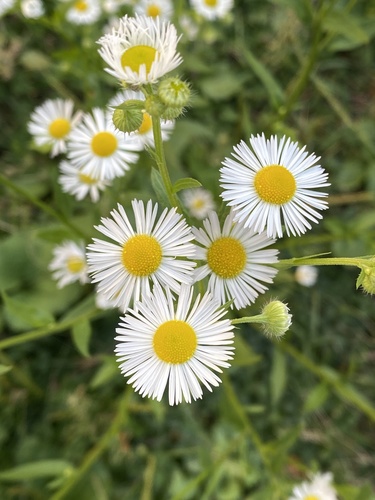
Erigeron annuus (L.) Pers. most often grows as an annual plant, though it may occasionally grow as a biennial. This species is herbaceous, with alternate, simple leaves and green, sparsely hairy stems that reach heights between 30 and 150 centimeters (approximately 1 to 5 feet). Its leaves are numerous and large relative to other species in the genus Erigeron. Lower leaves, especially basal leaves, are coarsely toothed or cleft, a trait that readily distinguishes this species from most other Erigeron. Upper leaves are sometimes, but not always, toothed, and may bear a few coarse teeth towards their outer tips. The flower heads have white petals with yellow centers; ray florets range in color from white to pale lavender, and 40 to 100 ray florets form each head. Flower heads are produced from spring through fall, with timing varying between individual plants. Erigeron annuus is native to North America and Central America. It is widespread across most of the United States, particularly in the eastern portion of its native range, and only occurs in scattered locations in the western and southernmost parts of its range. It has been introduced to many other regions worldwide, including Korea, Europe, India, and other areas of Asia. This plant grows best in full sun to partial shade on sites with ample moisture, and is tolerant of a wide range of soil conditions, including gravel and clay. Lower leaves often turn yellow and wither during hot, dry weather. As a native North American pioneer species, Erigeron annuus frequently colonizes disturbed areas such as pastures, abandoned fields, vacant lots, roadsides, railways, and waste areas. In these habitats, it often successfully competes with introduced invasive weeds. A wide variety of insect species pollinate its flowers, including multiple types of bees: little carpenter bees, cuckoo bees, halictine bees, and masked bees. It is also pollinated by numerous species of flies, including syrphid flies, bee flies, tachinid flies, flesh flies, anthomyiid flies, and muscid flies. Wasps, small butterflies, and other insects visit the flowers to a lesser degree to seek nectar, alongside a small number of pollen-feeding beetles. Caterpillars of Schinia lynx, the lynx flower moth, feed on the flowers and seeds of Erigeron annuus and other fleabanes. Lygus lineolaris, the tarnished plant bug, sucks juices from this plant. Several mammal species, including sheep, groundhogs, and rabbits, consume the foliage, flowers, and stems of Erigeron annuus.