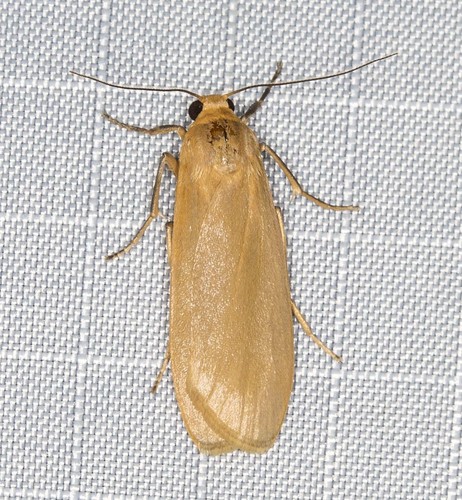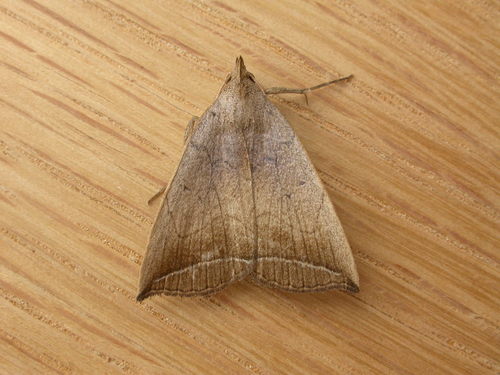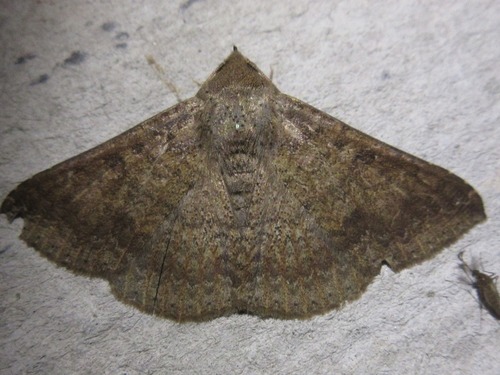
About Ericeia inangulata (Guenée, 1852)
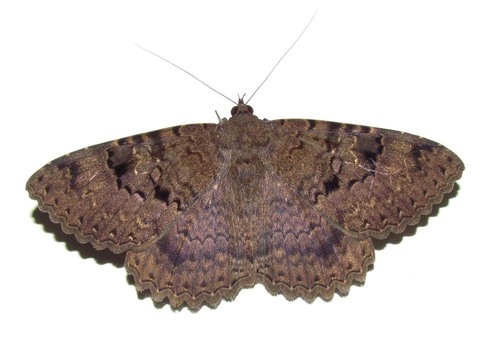
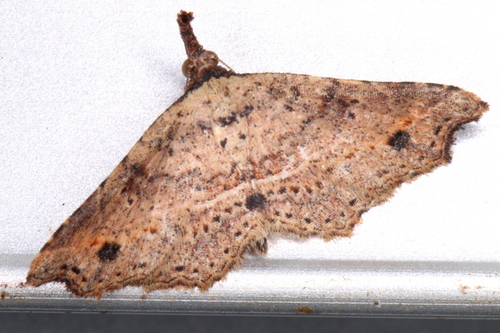
This species, Ericeia inangulata, has a wingspan of 47–48 mm. Adult moths are sexually dimorphic and show high variation in coloration. The third joint of the palpi is longer than in related species. Male hindlegs have tufts of long hair extending to the end of the tarsi. The mid tibia of males bears large masses of fluffy hair held within a fold. The body can be purplish grey, ochreous, reddish, or fuscous brown, and is more or less sprinkled with fuscous scales. The forewings feature indistinct, sinuous dark lines in the sub-basal, antemedial, medial, postmedial, and sub-marginal positions. The small orbicular spot and large reniform spot are both indistinct. A series of small dark specks runs almost along the wing margin. These markings may be obsolete or quite prominent. Each dark line may be double, and made up of disconnected small streaks or lunules. The area between the sub-marginal and medial lines may be suffused with fuscous, or be ferrous in color. Some forms have an elongated or prominent reniform spot. Ochreous-colored forms have a grey apical patch and a dark spot on the sub-marginal line above the inner margin. The hindwings have an indistinct medial line, with a crenulate line positioned beyond it. A waved submarginal line and a series of almost marginal dark specks are also visible on the hindwings. The larvae feed on a wide range of plant species, including Acacia mearnsii, Scutia myrtina, Cassia fistula, Cassia javanica, and species from the genera Albizia, Cassia, Dalbergia, Mimosa, Paraserianthes, Senna, Xylia, Adiantum, Lagerstroemia and Citrus.