About Ericameria nauseosa (Pall. ex Pursh) G.L.Nesom & G.I.Baird
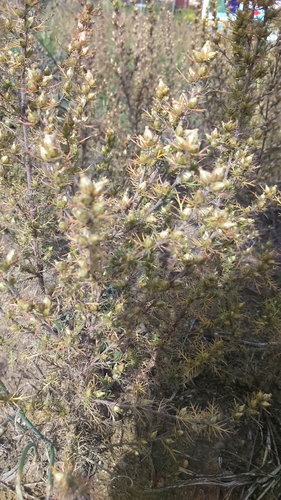
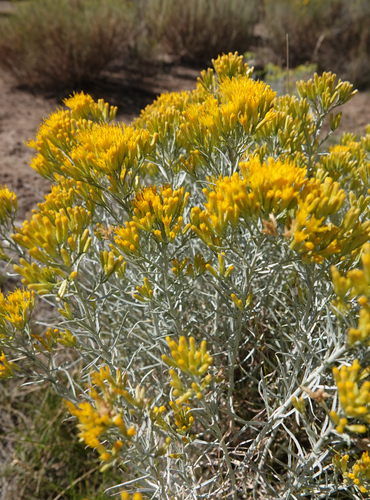
Ericameria nauseosa is a perennial shrub that ranges from 10 cm (4 in) to 2.5 m (8 ft 2 in) in height, and typically grows between 0.6 and 1.5 m (2 to 5 ft) tall. Its leaves measure 2–7.5 cm (3⁄4–3 inches) long, and can be narrow or spatula-shaped, with shape varying by subspecies. Both its flexible rubbery stems and its leaves are greenish-gray, and covered in a soft felt-like coating. It blooms from August to October, producing pungent-smelling golden-yellow flowers. Its flower heads are 6–13 mm (1⁄4–1⁄2 in) long, each containing 5 small yellow tubular disk flowers, and the heads grow in umbrella-shaped clusters at the ends of stems. This shrub reproduces both via seeds and root sprouts. It grows in arid regions across western Canada, the western United States extending from the western Great Plains to the Pacific coast, and northern Mexico. In summer, rubber rabbitbrush (this species) is only lightly or occasionally consumed by herbivores, alongside its associated species such as big sage and western wheat grass. However, it can be heavily browsed in winter when other food sources are scarce, and on overgrazed depleted rangelands. Species that feed on it include mule deer, elk, pronghorns, and black-tailed jackrabbits. It is classified as poor forage for nearly all domestic animals, though sheep in Utah have been recorded consuming significant amounts of the plant. Black-tailed jackrabbits also frequently use it for shelter. Dense stands of this species very commonly grow on poorly managed rangelands, in disturbed areas alongside roadways, and on abandoned agricultural land. It is often found growing together with Chrysothamnus viscidiflorus. This shrub, commonly called rabbitbrush, has become popular as an ornamental shrub for xeriscaping in regions where water conservation is a priority. It grows well in a wide range of the coarse, alkaline soils common to desert environments. Pruning the shrub back to a height of several inches in early spring, before new growth starts, can improve its ornamental value. The varieties Ericameria nauseosa var. nauseosa and Ericameria nauseosa var. speciosa are especially valued for ornamental use, as they rarely grow taller than 24 inches and often only reach 1 foot in height. Gardeners value this plant for its abundant late-season blooms as well as its attractive foliage. Among the Zuni people, the blossoms of the bigelovii variety of the nauseosa subspecies are used to make yellow dye, and the stems are used to make baskets. The Navajo also produced yellow dye from some of the plant's flower heads. Southwest Native American groups also cooked the plant's leaves with cornmeal to add to bread. Rubber rabbitbrush has been considered as a potential source of rubber as early as 1904. Multiple studies have investigated this possible use, including studies during World War I, World War II, and in 1987. Between 2005 and 2008, the University of Nevada conducted research into potential material applications of rubber rabbitbrush. One proposed commercial use is as a source of hypoallergenic rubber for products made for people with latex allergies.