About Eremophila deserti (A.Cunn. ex Benth.) Chinnock
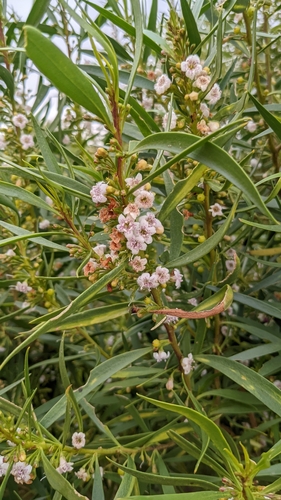
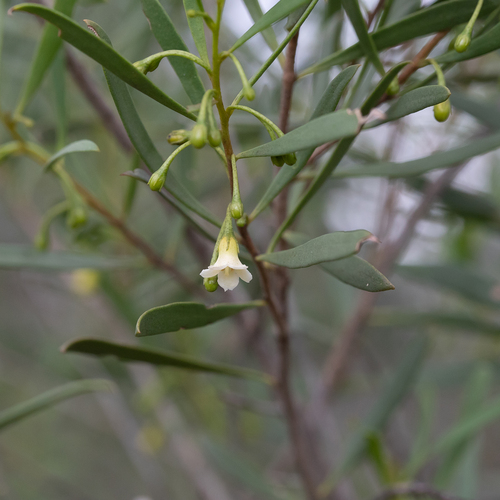
Eremophila deserti (A.Cunn. ex Benth.) Chinnock varies in growth habit from a low, spreading shrub 0.5 m (2 ft) tall to a tall, erect shrub that reaches up to 4 m (10 ft) in height. When young, its leaves and branches are sticky and shiny, a trait caused by the presence of resin. Its leaves are arranged alternately along stems; they are typically 25–50 mm (1–2 in) long and 3–6 mm (0.1–0.2 in) wide, and are glabrous, thick, linear, and sickle-shaped with a hooked tip. This species often produces separate male and female flowers, though other flowers on the plant have both male and female reproductive parts. The flowers are honey-scented, and are borne singly or in groups of up to three in leaf axils, on glabrous, sticky stalks that are 7–12 mm (0.3–0.5 in) long. There are 5 glabrous, green, tapering triangular sepals, each 1–3 mm (0.04–0.1 in) long. The 5 petals are joined at their base to form a tube 2–6 mm (0.08–0.2 in) long, with petal lobes at the end of the tube extending a further 1.5–3 mm (0.06–0.1 in). The petals are white to cream-colored, and sometimes have a slight pink tint near their bases. All petal lobes have a similar size and shape except for the lower middle lobe, which has a small notch at its center. The petal tube is mostly glabrous, with the exception of its inner surface. Unlike most other eremophilas that have 4 stamens, Eremophila deserti has 5 stamens. These stamens almost completely block the entrance to the petal tube. Flowering occurs in most months of the year, and is followed by the development of fruits. The fruits are fleshy, pale yellow when young, and turn brownish purple as they age. They are oval to almost spherical in shape, and 4–6.5 mm (0.2–0.3 in) long. Eremophila deserti has a wide distribution across inland Australia. It is widespread in south-eastern Queensland, where it most often grows in brigalow. It grows in Eucalyptus woodland in New South Wales and Victoria, and in mallee woodland in South Australia and Western Australia. Its distribution is more scattered across Western Australia, where it only occurs south of 25°S latitude, and is most commonly found along the Nullarbor Plain.