About Eremophila alternifolia R.Br.
Species Identification and Growth Form
Eremophila alternifolia R.Br. is a many-branched shrub that varies in height, usually growing between 1 and 4 meters (3 to 10 feet) tall.
Branch Characteristics
Its branches have numerous raised resin glands and raised leaf scars.
Leaf Arrangement and Size
Leaves are arranged alternately, typically 20 to 40 millimeters (0.8 to 2 inches) long and 1 to 3 millimeters (0.04 to 0.1 inches) wide, though other sizes are common.
Leaf Shape
Leaves range in shape from nearly cylindrical to flattened egg-shaped, and end in a small point.
Flower Color and Flowering Period
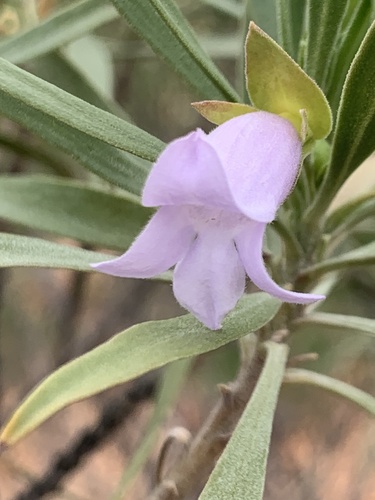
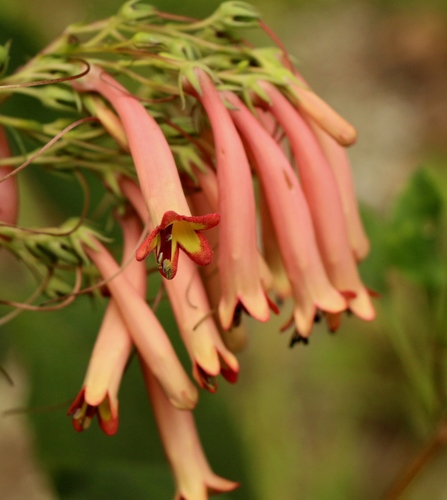
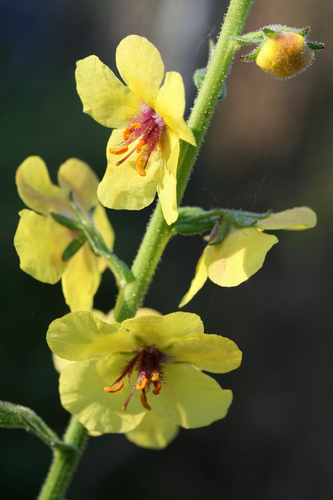
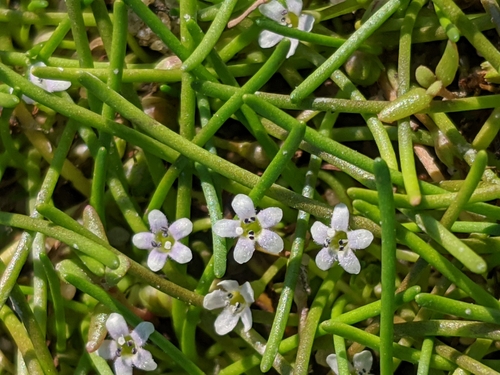
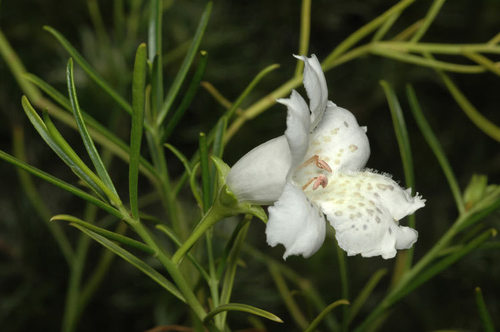
Flowers may be purple, red, pink, white, cream, or yellow, and are present on the plant from early winter to early autumn; recorded flowering also occurs from June to October.
Flower Stalk Characteristics
Flowers grow singly in leaf axils on an S-shaped stalk that is usually 20 to 40 millimeters (0.8 to 2 inches) long.
Sepal Characteristics
There are 5 greenish-yellow or reddish egg-shaped sepals, mostly 7 to 10 millimeters (0.3 to 0.4 inches) long, with the outer sepals slightly smaller.
Petal Structure
The 5 petals are 18 to 30 millimeters (0.7 to 1 inch) long, joined at the base to form a tube.
Petal Lobe Shape
The upper four petal lobes are pointed, while the lower lobe spreads outward.
Fruit Characteristics
After flowering, the plant produces cone-shaped, dry, woody, glabrous fruit that is 5 to 7 millimeters (0.2 to 0.3 inches) long.
Distribution and Habitat
This species occurs in arid areas of Western Australia, South Australia, the Northern Territory, and the Barrier Range in New South Wales, growing in many different habitats on stony or red soil.
Traditional Medicinal Uses
Parts of Eremophila alternifolia have been used as traditional medicine. A small quantity of the plant was used in preparations to treat colds and throat inflammation; an infusion of the leaves was used as a soporific, and other parts of the plant were combined for use as a topical treatment.
Indigenous Name
An indigenous name for this plant is Tarrtjan, which translates to "Goldfields", referring to the region in Western Australia where the plant occurs.
Pharmacological Properties
Compounds such as verbascoside found in the leaves of this species have been shown to have antibacterial properties and the ability to dilate blood vessels.