About Eremobius phoenicurus Gould, 1839
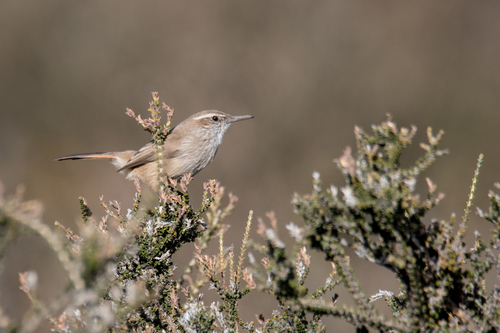
The band-tailed earthcreeper (scientific name Eremobius phoenicurus Gould, 1839) measures 16 to 17 cm (6.3 to 6.7 in) in length and weighs 28 to 34 g (0.99 to 1.2 oz). It is a relatively small earthcreeper with a thin, straight medium-length bill. The appearance of males and females is identical. Adult band-tailed earthcreepers have a white supercilium, a dark stripe behind the eye, and rufescent cheeks. Their crown and upperparts are plain dull gray-brown. The central pair of feathers on their tail are fuscous blackish with dull gray-brown bases, while all other tail feathers have a sharp dividing line between dark rufous bases and black ends. Their wings are dull gray-brown. Their throat is whitish with grayer edges, their breast and belly are pale dull gray-brown with paler streaks on the breast and flanks, and their undertail coverts are whitish. Their iris is dark brown, their bill is black or blackish brown with a pale gray or horn-colored base to the lower mandible, and their legs and feet are blackish brown or blackish. Juveniles have pale feather edges on their forehead and much fainter streaking on their underparts compared to adults. The band-tailed earthcreeper is distributed in southwestern Argentina between Neuquén and Santa Cruz provinces, and in the northeastern part of the Magallanes Region, which is in far southern Chile. It lives in arid scrublands and temperate grasslands, and prefers thinly vegetated plains, plateaus, and slopes. Its elevation range extends from near sea level to 1,200 m (3,900 ft).