About Erebia tyndarus Esper, 1777
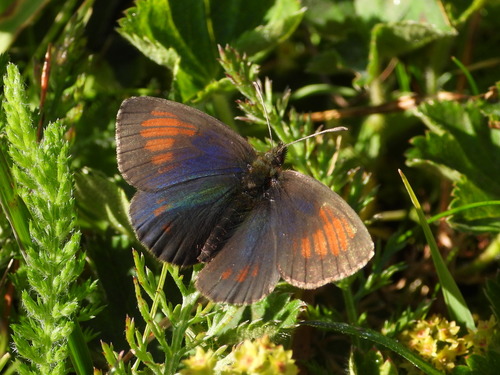
Erebia tyndarus Esper, 1777, commonly known as the Swiss brassy ringlet, is a mid-sized butterfly in the genus Erebia with a wingspan of around 35 mm. It has the blackish-brown upperwings typical of this genus, plus a brassy sheen or green-gold lustre on its forewings that gives the species its common English name. These wing colours are produced by light interference on the wing scales. The upper surface of the forewings, and sometimes also the upper hindwings, carry an extensive coppery or orange patch: this patch sits near the tip of the forewing, and runs parallel to the outer margin on the hindwing. Inside this patch are black eyespots, each with a white dot at the centre. There are two of these spots positioned immediately next to each other on the forewing, and three or four more evenly spaced spots on the hindwing. These small spots do not touch one another. However, the hindwing spots may be reduced or entirely absent, particularly in males, which also have an overall darker body coloration. The underwings are cryptically coloured a lighter greyish brown. A darker band arches between the front and back margins of the hindwing; this band has a prominent silvery sheen also seen in closely related Erebia species, and it is conspicuous from a distance when these butterflies fly in sunlight. The reddish patches and eyespots of the forewing are also present on the underwings, but these markings are usually absent from the under surface of the hindwings. Adult butterflies only fly for a short period during summer, mainly in July and August, and they feed on nectar from their preferred yellow mountain flowers. The eggs are green and oval, with many visible longitudinal ribs. Caterpillars range in colour from grey-green to grey-brown, and have dark longitudinal lines. The pupa is thick and brown in colour. This species is univoltine, meaning it produces one generation per year. Its caterpillars feed on grasses in the Poaceae family, especially sheep's fescue (Festuca ovina), matgrass (Nardus stricta), and various other fescues (Festuca) and meadow-grasses (Poa). Caterpillars overwinter, then pupate on the ground around May and June. This species is distributed in the Alps of France, Italy, Germany, Switzerland, Liechtenstein, in Austria's Vorarlberg region, and in adjacent areas. It lives above the treeline in clearings and rocky alpine meadows, at altitudes between 1,200 and 2,700 metres (3,900–8,900 ft).