About Erebia triarius von Prunner, 1798
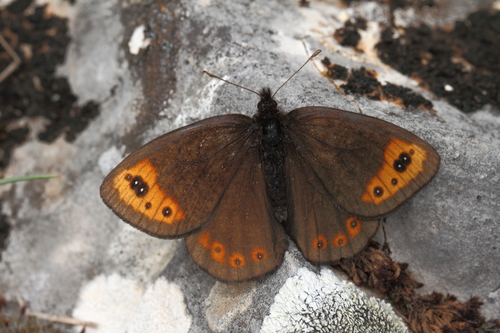
This species was first described as Erebia triarius by von Prunner in 1798, and was also previously referenced in Seitz's work under the synonyms Erebia evias God. and bonellii Hbn. It is always somewhat larger than the preceding species Erebia stygne. The upper side of its wings is dark black-brown. The forewing has a russet-red or reddish yellow transverse band, which holds 5 black ocelli with white centers that vary in size: 3 of these ocelli sit near the costa and are united, while the remaining 2 are positioned further back and are somewhat smaller. The band on the hindwing consists of 4 to 5 oval brown spots, each of which bears a black ocellus with a white center. The underside of the forewing is marked similarly to its upper side. In males, the hindwing is black, thinly dusted with grey, and bears a more or less dark median band that curves slightly outward between the veins; 3 to 5 black ocelli with white pupils are present in the lighter discal margin. In females, the underside is brownish grey; the costal and distal margins of the forewing are marbled with grey and brown, matching the pattern of the hindwing, and the median band of the hindwing is more prominent than it is in males. Two named forms of the species are recognized. The smaller form pyrenaica Stgr. from the Pyrenees has more strongly marked undersides, a narrower russet-red band, and ocelli that are either absent or strongly reduced. The form hispanica Zap. (plated as 37 a) is somewhat smaller, has a lighter transverse band in both sexes, smaller ocelli, and unlike nymotypical evias, the upper 3 ocelli in the forewing band are not united and instead stand separated one below the other. This butterfly appears as early as mid-May in warmer localities, and flies from June to August at higher altitudes. It occurs on grassy slopes and is plentiful across most of its flight areas. Originally recorded localities include the Pyrenees, the lower Alps of Southern France, Wallis, and Southern Tyrol. It is a mountain butterfly with a broader documented distribution across Albania, Andorra, Austria, Switzerland, France, Italy, Spain, Portugal, and Yugoslavia.