About Erebia pronoe Esper, 1780
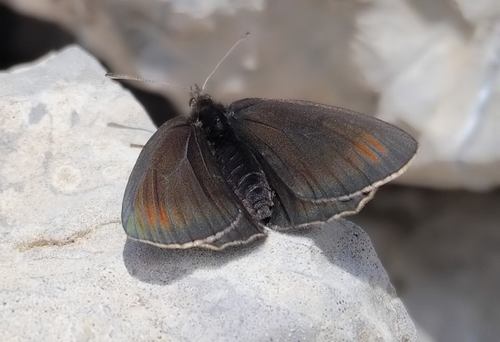
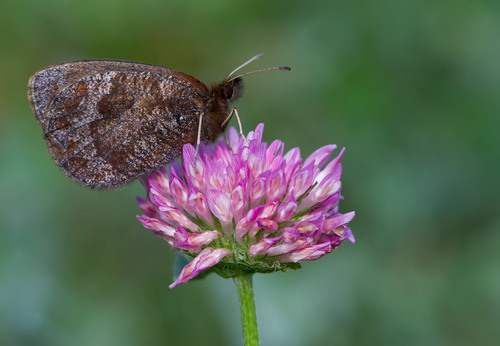
Erebia pronoe Esper, 1780 (synonym arachne Hbn.) individuals have dark black-brown upper wings. A red-brown band, wider on the anterior end and narrower on the posterior end, sits on the forewing; this band has 2 white-centred ocelli on the costal side, plus an additional smaller ocelli toward the hindmargin. The band on the hindwing is made up of 3 rounded russet-brown spots with black eye-dots, which occasionally have white pupils. The underside of the forewing is dark sombre red-brown, with a lighter, distinctly contrasting band; the distal margin and apex are dusted with bluish grey. The underside of the hindwing is bluish- or ashy-grey with black-brown dusting; a curved, posteriorly broadly dentate, almost uniformly brown band crosses its centre, sharply bordering the distal area. The distal area holds one or two black blind ocelli. Females are much lighter on both upper and lower sides than males, with more prominent markings, larger ocelli; the base and submarginal band of the female hindwing underside are light white-grey, making the brown middle band stand out in sharp contrast. This species is distributed across the whole Alps, and also occurs in the Apennines, Pyrenees, Carpathian Mountains, South and South-West Russia, and the southern slopes of the Caucasus. The subspecies pitho Hbn, found in the Swiss Alps and southern Jura, has either entirely absent upper wing markings, or only a faint reddish tint remaining from the original markings. The two ocelli near the apex are small with minute white pupils; some individuals have no ocelli at all, and are simply dark black-brown with a faint violet sheen. Their underside matches the originally described form. In the form almangoviae Stgr., the subcostal ocelli, while present in the brown band, lack distinct white pupils; the ocelli on the hindwing also have no white pupils, or only faint traces of them. The species' egg is barrel-shaped, ribbed, and white. The larva is dirty reddish yellow, with a dark dorsal stripe; its lateral markings are made up of streaks, and its spiracles are black. Larvae develop from October to July on Poa grasses. The pupa is bone-yellow on its anterior section marked with dark colouring; the abdomen is cinnamon-coloured with dark incisions. Pupae position themselves among grass roots such that only the head is visible. Adult butterflies emerge in August and September, flying with a jerky fluttering flight over meadows and grassy slopes in mountain and alpine regions. In some years they are not rare, and occur up to 6000 ft in high mountain ranges. One generation of adults is produced per year, with adults on wing from June to September. The larvae feed on Festuca grass species.