About Erebia pluto von Prunner, 1798
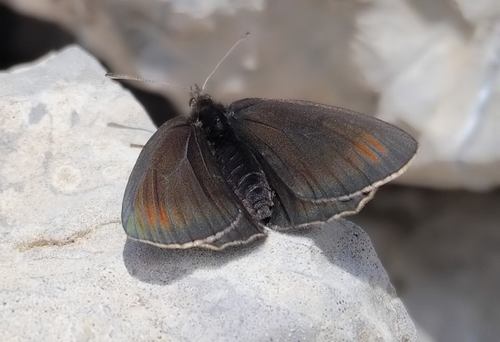
This description of Erebia pluto, compiled from Seitz, covers three forms of the species that were previously treated as separate taxa. The form originally named E. glacialis Esp. (synonym = alecto Frr.) has a sombre black-brown upperside on both wings. The forewing bears an obsolescent red-brown band that often barely contrasts with the base ground color. The hindwing is either simply blackish brown, or has a faint red-brown tint in the area where a distal band would occur. The underside of the forewing is dark russet in the center, and is slightly lighter in females. The underside of the hindwing is uniformly dark black-brown in males, and blackish grey in females, being slightly lighter toward the distal edge. This form is distributed across the entire Alps, where it occurs above the tree line on boulder-covered sites, and adults fly in July and August. The form alecto Hbn. (synonyms = persephone Esp., nicholli Oberth.) matches the form glacialis in all other features, but both sexes have two white-centered ocelli before the apex of the forewing, which are also visible on the wing underside. The hindwing additionally has 2 to 4 white-centered ocelli; these are generally only partially present on the underside, or may be absent entirely. This form is more commonly found in the northern and eastern Limestone Alps, occurring only sporadically and mostly in small numbers of individuals. The form pluto Esp. (synonyms = tisiphone Esp., duponcheli Oberth.) has uniformly black upper and lower wing surfaces. Only females occasionally develop a faint reddish-brown tint on the upperside of the forewing. This form is found in the Abruzzi and the highest elevations of the Alps. For the full species Erebia pluto von Prunner, 1798, adults are on wing from June to August. There is one generation per year. The larvae feed mainly on Festuca, Poa annua, and Poa minor.