About Erebia pharte Esper, 1777
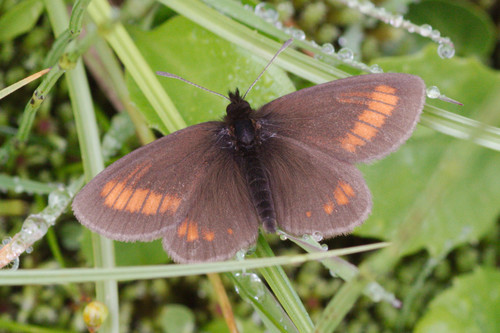
This species, Erebia pharte Esper, 1777, matches the shape and size of Erebia melampus, but its forewing is narrower and more elongated, with a less rounded apex. The yellowish brown distal band on the forewing is interrupted by veins; it usually extends close to the hindmargin, and sometimes only reaches the center of the wing. The hindwing most often has 3 to 4 yellowish brown spots of varying sizes; these spots may be completely absent, or only appear as small brown dots. On the underside of the wing, the forewing band is continuous and a slightly lighter yellow-brown than the upper side, while the disc shows diffuse red-brown coloration. Underneath, male hindwings are dark brown, with the same yellow-brown spots seen on the upper side, though these spots are more prominent. Lighter-colored females have greyish yellow dusting on their underside, most noticeably along the costal and distal margins of the wings. The typical form inhabits the higher Vosges and the Central Alps, particularly in swampy meadows, and rarely occurs above the tree line. The aberration ab. phartina Stgr. has the brown-yellow macular band of the forewing reduced to only 2–3 spots of varying sizes, with the hindwing bearing only small, faint spots that may even be absent. This aberration occurs singly alongside the typical name form, especially at higher altitudes. The form fasciata Spul., which is found in Carinthia, has an especially dark ground color. In this form, the band is reddish orange in males and yellowish orange in females, it is broader and more extended on the hindwing, and features lighter spots that are remnants of ocelli. This species is distributed across France, Germany, Italy, Liechtenstein, Poland, Romania, Slovakia, Slovenia, and Switzerland.