About Erebia pandrose (Borkhausen, 1788)
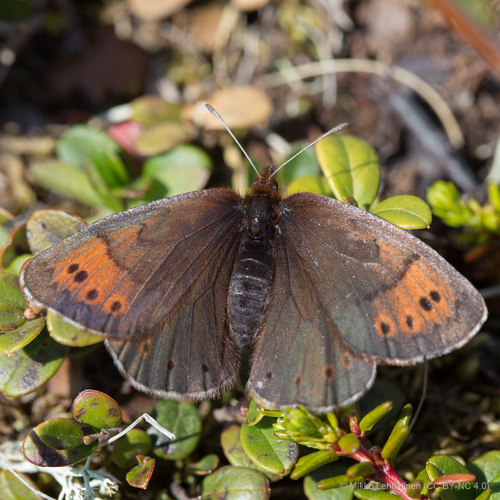
This entry describes Erebia pandrose (Borkhausen, 1788), originally referenced under the synonym Erebia lappona Esp. in Seitz. The upperside of both wings in the nymotypical form is black-brown and somewhat glossy; female ground color is lighter and more grey-brown. The forewing has a rather broad russet brown band that does not reach the hindmargin, and bears 4 black non-pupiled ocelli. The 2 upper ocelli stand close together and are somewhat shifted proximad. This band varies in distinctness across individuals. The hindwing has 3–4 black ocelli in russet-brown rings, or is entirely unmarked and unicolorous. The underside of the forewing has a russet-brown central area, with costal and distal margins dusted with white-grey or bluish white, and a black-brown hindmargin. The ocelli match those on the upperside, but are mostly placed within russet-yellow rings. The underside of the hindwing is whitish or bluish grey, with a median band bordered both proximally and distally by a thin brown dentate line. In females, this median band is more or less dusted with brown; the dentate lines are darker and broader, making the band more prominent than in males. Before the distal margin there are 2 or 3 black dots, which are sometimes absent. The head, thorax and abdomen are black; the abdomen is ashy grey on its underside. Antennae are brown above, grey beneath, with a yellow club. This species is found in the Pyrenees, Apennines, Alps and Carpathians, mostly only at considerable altitudes. Aberration ab. pollux Esp. (synonyms: dubius Fuessl, aglauros Hbst., baucis Schk.) has an underside dusted with white-grey and lacks markings. It occurs singly among nymotypical individuals, in Graubünden and Finmark. Aberration ab. castor Esp. (equal to pandrose Bkh.) has a duller upperside color, with 2 subapical dots. The underside of the hindwing is very evenly leaden-grey, crossed by 2 sharply marked black-brown dentate lines. It is an insignificant aberration, which likely occurs among nymotypical specimens anywhere in the Alps. The form sthennyo Grasl. occurs in the Central Pyrenees. In this form, the distal band of the forewing is yellowish red rather than russet-brown, and is not, or only indistinctly, defined on its proximal edge. Ocelli are bordered with yellow rings on both the upper and underside. Aberration ab. stelviana Gumpp. has no ocelli on the forewing upperside. It was first recorded from the Tirolese Alps, but occurs as an aberration among nymotypical specimens almost everywhere. In the northern form mantoides Btlr., the ocelli on the underside of the forewing are contiguous, forming a chain. Both Central-European mountain forms and arctic forms vary so much individually that nearly all aberrational forms appear in both regions. Full-grown larvae are grass-green, with black heads, a black dorsal line, black lateral macular lines, and black spiracles. They feed on grass, and contract like a slug when touched. In May, larvae develop into an obtuse pupa that lies free on the ground; the anterior part of the body is green, and the abdomen is brownish. Adult butterflies emerge in June or August depending on altitude. In the Alps, the species is usually encountered only from the tree line up to the snow line. It flies especially on stony slopes with sparse grass cover, prefers to settle on the ground, and rarely visits flowers. It is very shy, so it is not easy to catch. Adults are on wing from June to August, with one generation per year. Larvae mainly feed on Festuca, Poa and Sesleria species.