About Erebia mnestra Hübner, 1802
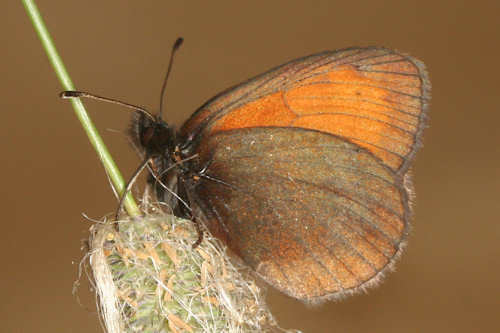
This species, formally Erebia mnestra Hübner, 1802, matches the general body shape of Erebia melampus, but is larger in size. For males, the forewing band is reddish to brownish yellow, with a sharp distal edge, while the proximal edge fades gradually into the black-brown base wing colour. Two small black pupils sometimes occur near the apex within this band, though these are most often absent. The hindwing sometimes has a brown band split by veins into 3 to 4 spots, which may also be absent. The underside of the forewing is russet-brown, with costal and distal margins that are dark brown, matching the colour of the entire hindwing. Females are somewhat paler in overall colour; their forewing band is russet-yellow and sharply defined on both edges, and typically holds two ocelli with white centres that are visible even on the wing underside. Specimens with a particularly prominent band have 2 to 3 small black white-centred ocelli in the band. In most females, however, the full band is absent, and only a few diffuse brown spots appear in its place. The underside of the female forewing matches that of the male, but the band is lighter, and the wing section from the band to the base is russet-brown. The female hindwing underside is light brown, covered overall in fine yellowish grey speckling, and crossed centrally by a slightly lighter band that has slightly dentate edges on both sides. Antennae are black on the upper side and white on the underside. This species occurs in the Swiss and Tyrolese Alps, where it is locally distributed. The subspecies gorgophone Bell., found in southern France, is smaller and has a broader band.