About Erebia meolans von Prunner, 1798
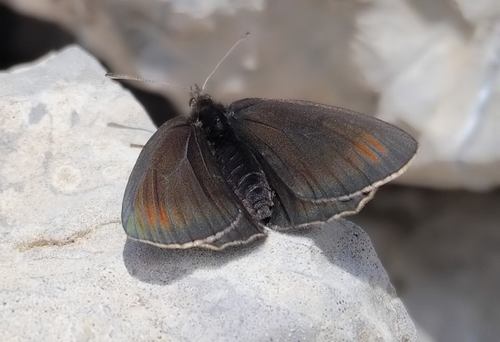
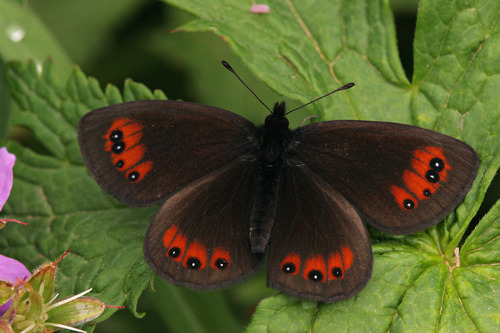
This is Seitz's description of Erebia meolans von Prunner, 1798, referenced here as E. stygne O. (= pirene Hbn.). The upper side of both wings is dark black-brown. The forewing has a russet-brown band before the distal margin that is broad anteriorly and strongly tapers behind; this band holds 2 black, white-centred ocelli in its upper portion, with an additional somewhat smaller ocellus visible toward the hind margin. The hindwing has 3 to 4 white-centred ocelli edged with brown. The underside of the forewing is slightly lighter than the upper side in both males and females, with a distal band that is broader, lighter brown, and continuous. Beneath the hindwing, males are dark brown, while females are brown grey. The ocelli match their placement on the upper side, but are smaller and narrowly edged with brown. Specimens from the Black Forest are much brighter coloured. In these specimens, the broad russet yellow band of the forewing starts near the costal margin of the forewing and extends to the hind margin, staying nearly even in width. This band always contains 3 to 5 large black white-centred ocelli, and especially often in females, an additional smaller ocellus with a white pupil is present above the first ocellus toward the apex; this extra ocellus is not visible on the underside. On the hindwing of these Black Forest specimens, the brown band is as wide as it is on the forewing, and the 3 to 4 ocelli are similarly large, with conspicuous white pupils. The form pyrenaica Ruhl, which is found in the Western Pyrenees in June, differs from the originally described form only in having reduced red colour. In the aberration valesiaca Elw., which occurs in Wallis, on the Simplon, and even in the Pyrenees, russet-red colour is effaced in females and only remains as faint traces, while it is completely absent in males. The stygne population occurs in the Black Forest, the Thuringian Forest, the Jura, the Alps, the Vosges, the Pyrenees, and the Apennines, and extends eastward to Armenia; it is active in June and July. Butterflies begin to appear already below 3000 ft, and only rarely go above the tree line.