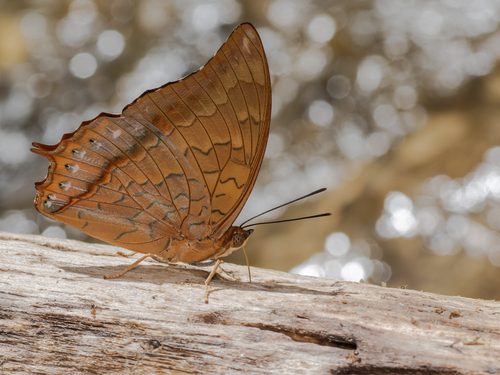
About Erebia melampus Füssly, 1775
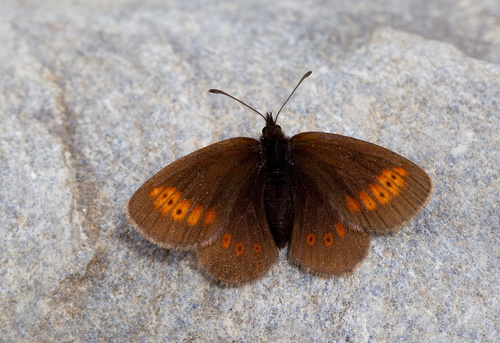
Erebia melampus, also known as the Lesser Mountain Ringlet, is a small butterfly with a wingspan of 30–36 mm. Individuals of this species have brown wings. A postmedian band of orange oval to round markings, which contain small black spots, is visible on the forewings. The hindwings have three or four postdiscal eyespots. According to Seitz's description, this species is one of the most common Erebia found in the Alps. It also occurs in the Pyrenees, the High Tatra, and the western and southern Carpathian Mountains. The base wing color is black-brown, the margin is reddish grey, the antenna is blackish on the upper side, and whitish grey on the underside. The forewing has a russet macular band interrupted by veins, which holds 2 to 3, more rarely 4, black ocelli. Before the distal margin of the hindwing, there are 3 to 4 ovate ferruginous spots that bear black dots. The underside of the wings is paler, more reddish grey, with the band and spots remaining distinct. Female individuals have more elongate wings, with lighter base color and band than males. A form now classified as the full species Erebia sudetica occurs on the Altvater in Silesia; this form differs from the alpine form of Erebia melampus in having a broader, lighter distal band on the forewing that regularly holds 4, sometimes even 5, black dots, and larger, more prominent ferruginous yellow spots on the hindwing than name-typical Erebia melampus. The egg of Erebia melampus is elliptic, longitudinally ribbed, and sulphur-yellow, turning reddish grey before the butterfly emerges. Before its final moult, the larva is clay-colored; after the moult, it becomes bright green, with a dark dorsal line finely bordered with light color, and indistinct lighter subdorsal lines edged with dark. It has a light green lateral stripe, with small orange stigmata above this stripe. Larvae can be reared on Poa annua. The pupa is pale yellowish grey with darker markings, and is free on the ground. Adult butterflies are active in July and August. They often fly in great abundance across grassy alpine meadows, occurring up to 2600 m, with a low, slow, straight flight. This European endemic species is distributed across the Alps from the Maritime Alps to eastern Austria, found in France, Germany, Italy, Liechtenstein, Switzerland and Austria. It prefers grassy habitats, in woodland or open areas, at elevations between 800 and 2,400 metres (2,600–7,900 ft) above sea level.