About Erebia medusa (Denis & Schiffermüller), 1775
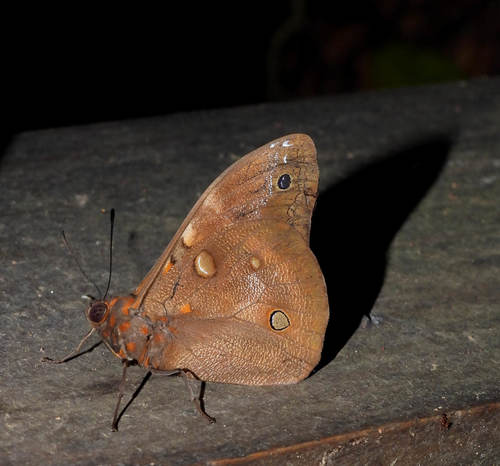
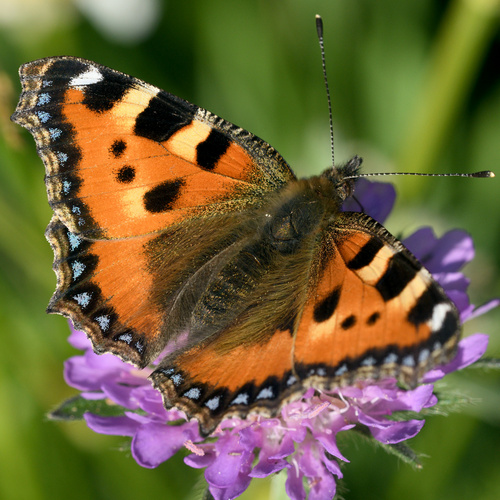
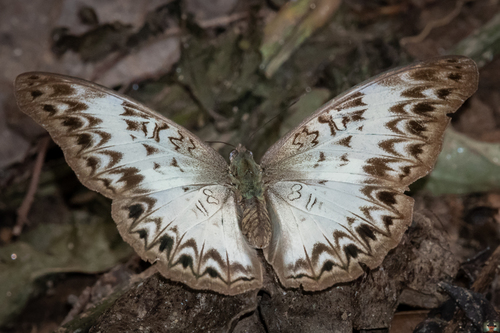
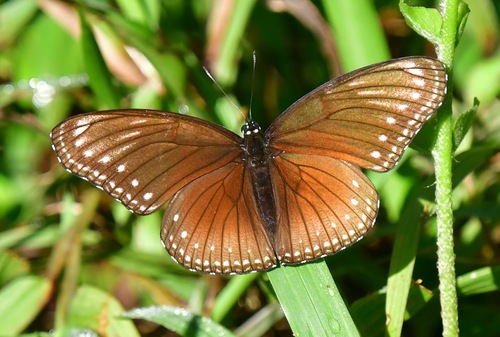
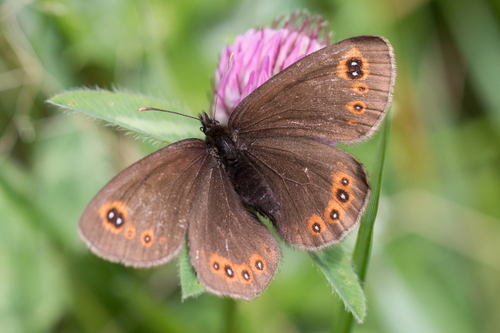
Erebia medusa (Denis & Schiffermüller), 1775 has a wingspan of 44–52 millimetres (1.7–2.0 in). Its antennae are club-shaped, and its wings are dark brown. The forewings bear an orange-yellow postmedian band, with two adjacent pupillated ocelli near the apex and one or two smaller ocelli. The hindwings have at least four bright orange-ringed eyespots. The number of these eyespots is quite variable, and the upper and lower sides of the wings have similar patterning. Females are generally paler than males. The ribbed eggs are white or light green, speckled with brown. Fully grown caterpillars are about 20 millimetres long, and are light beige or pale green with a dark dorsal stripe. The chrysalis is light brown. In Seitz's description, E. medusa has two larger, white-centered black ocelli placed close together near the apex of the forewing's reddish yellow macular distal band; these are sometimes joined. Ocelli in the other spots (usually 3) are smaller, and often appear as plain black dots. The hindwing has 3–4 separate reddish yellow spots, each bearing a white-centered black ocellus. The slightly lighter underside has the same pattern as the upper side. Variation in the number of ocelli and reddish yellow spots is common. Several forms and variants have been described. The subspecies psodea Hbn. has a somewhat lighter and broader macular band; its ocelli, especially those in the hindwing band, are larger with a more noticeable white pupil. This form occurs in South Hungary, the Balkans, Caucasus, and Western Siberia, and is occasionally reported as an aberration in Central Europe. The smaller form procopiani Hormuz. has blind ocelli, and is found in Bukowina. The smaller subspecies hippomedusa O. occurs in alpine regions, and has a reduced macular band and smaller ocelli. The variant polaris Stgr. is only slightly larger than hippomedusa, with the macular band becoming indistinct on the underside of the hindwing; it is found in Lapland, Finmark, and Norway. The subspecies uralensis Stgr. has fewer ocelli, and is otherwise little different from polaris, forming a transition to this variant, with a differing hindwing underside. It occurs in the Southern Ural, the Kirghizsteppe, and adjacent districts of Siberia. The variant subalpina Gumpp matches medusa on the underside, but is deep black on the upper side, with ferruginous red black-dotted spots on the forewing; it is found in the Bavarian Alps up to 3000 ft. The variant transiens Ruhl-Heyne is closer to psodea, with larger and more numerous ocelli than the nominal medusa, and females have a more or less grey-dusted hindwing underside; it occurs in East Siberia. Mature larvae are light green, with a light-edged dark dorsal line, a light line above the stigmata, a white line above the legs, and 2 black ocelli on the head. They feed on various grasses including Panicum sanguinale and Millium effusum, hibernate, and form a light grey pupa by the end of April. The pupa rests on the ground in a loose web, and the adult butterfly emerges after 4 weeks. Adults are on the wing from the end of May to early July. They inhabit woodland meadows, grassy roads, road ditches, and similar areas; their flight is slow but irregular. Males are very abundant, while females remain at rest and only become active toward the end of the flight period. This species is present across most of Europe, extending from France through central and eastern Europe to western Asia. Its preferred habitats include clearings, grassy and humid wastelands, damp grasslands, moors, and sunny forest edges, at elevations between 300–2,300 metres (980–7,550 ft) above sea level.