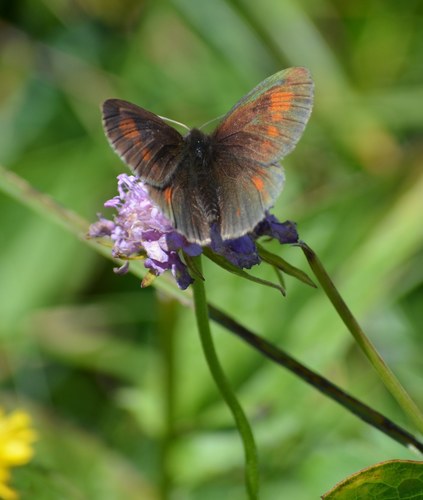
About Erebia manto Esper, 1777
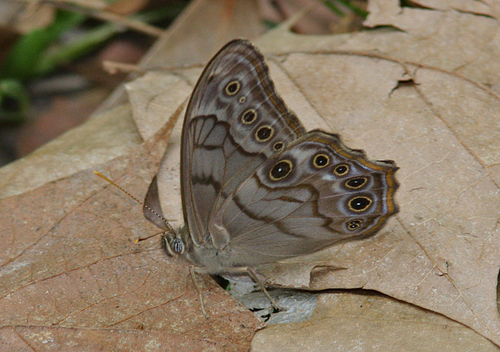
This species is referenced in Seitz as E. manto Esp., with synonyms erina F., pyrrha F., and oeme var. Esp. The russet band on the forewing usually only forms oval spots, which contain 2 to 3 black dots. The hindwing often, but not always, has a number of small, fading russet-red spots. The underside of males is brown, with the forewing band more prominent and better defined than it is on the upper side, and it is often continuous. The hindwing band is made up of several russet-red spots, which occasionally bear black dots. Females are visibly lighter on the underside: the central area of the forewing is brownish, while the fore, distal margins, and the hindwing are densely dusted with yellowish grey. There are several ochreous spots at the base of the hindwing, and some yellow spots extend from the costal margin to below the apex of the cell. These yellow spots sometimes merge into a broader, shortened band, and smaller additional spots often sit near them, forming a row parallel to the distal margin. In males, fringes are somewhat lighter than the ground colour of the wing; in females, fringes are grey. The species is distributed across the entire Alpine mountain chain, and is abundant in many locations. It occurs on grassy slopes in alpine and subalpine regions, and is also found on the mountains of Auvergne, the Pyrenees, and the mountains of Hungary. Aberration bubastis Meissn., also called pyrrha maccabaeus Frr., comes from the northern Central Alps. On the underside of its hindwing there is a white band, and its fringes are darkly chequered. Aberration caecilia Hbn. is uniformly black-brown with no spots on its upper side; it occurs alongside the typical form in Switzerland and the Tyrol, but is rare. A similar unmarked form with a greyish brown ground colour is found in the Pyrenees; this is constans Elwes, also called caecilia Dup. A very small form, pyrrhula Frey, flies high above the tree line in the Swiss and Tyrolese Alps. It is scarcely as large as pharte. The forewing has small streak-like russet-brown spots, which only rarely contain small black dots. The hindwing usually has no markings, only occasionally showing small brown wedge-shaped spots. Its underside matches that of typical Erebia manto, just with markings reduced. trajanus Hormuz. differs from the originally described form primarily on the underside. The forewing of this form is light reddish brown, with yellowish grey dusting towards the apex and costa. The light reddish yellow band has tooth-like indentations between the veins on both its distal and proximal edges, or only has weak indentations on the proximal side. The band always bears two distinct ocelli in cellules 4 and 5. The underside of the hindwing is greenish grey. The spots of the distal band vary in size, and are whitish yellow rather than reddish yellow like in the typical form, and the basal spots are completely absent. This form is distributed in Bukowina. The form from the Vosges has been described as vogesiaca Christ., and its females lack light basal spots on the underside of the hindwing. The larva is greenish yellow, with honey-coloured head and legs. It has two rows of black comma-shaped spots along its back. The pupa is yellow, with lilac markings. The adult butterfly emerges three weeks after pupation; the pupa rests freely on the ground. The species is abundant, and is in flight from June to August, with adult flight occurring from July to August. Larvae feed on species of Festuca, primarily Festuca rubra.