About Erebia ligea (Linnaeus, 1758)
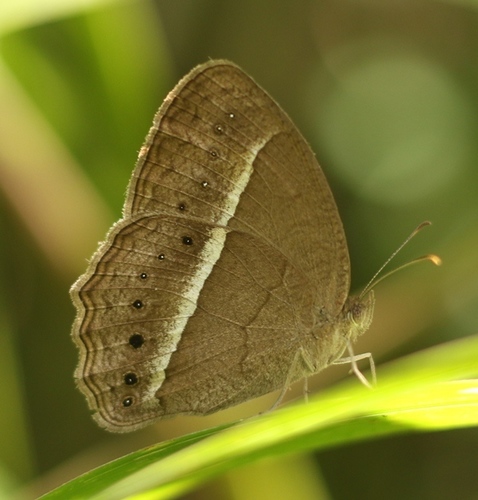
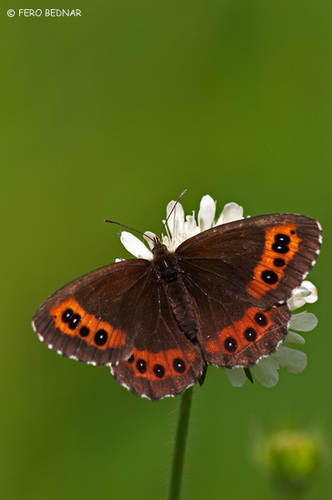
The Arran brown (Erebia ligea (Linnaeus, 1758)) is a medium-sized butterfly with a wingspan ranging from 30 to 46 mm (1.2 to 1.8 in). Females are typically slightly larger than males. The upperside of both its forewings and hindwings is dark greyish brown, with a reddish-orange band near the margin that bears a series of black spots. Most spots are small, and some of these spots have white centres. The underside of the forewing is dark brown, with a reddish band containing black, white-centred eyespots near its outer edge. The underside of the hindwing is brown, edged with a row of more or less distinct dark-coloured eyespots. The side of this row of eyespots closest to the wing base lies near the centre of the wing, and there are one or two white patches on this section of the wing. For females, the basal part of the hindwing is a darker brown than the rest of the wing. A short description of this species was published by Wheeler in 1903. This butterfly can be told apart from the similar Lapland ringlet (Erebia embla) and Arctic ringlet (Erebia disa) by the presence of white blotches on the underside of its hindwings, which the other two species lack. It can also be distinguished from the Arctic ringlet because the Arran brown always has eyespots on its hindwings, while the upperside of the Arctic ringlet's wings is plain brown. Another very similar species is the dewy ringlet; the dewy ringlet has a more rusty red forewing, and the red strip along the underside of its wings is not continuous. The presence of the Arran brown in the British Isles is considered questionable. Historical collections of the Scotch argus (Erebia aethiops) include some Arran brown specimens mixed in with very similar Scotch argus specimens. The original record of this species comes from the Isle of Arran, in the Clyde Isles of Scotland, dating to 1803, and the species takes its common English name from this location. The Arran brown is native to northern and south-eastern Europe. It can be found flying in July and August, in habitats including grassland, open woodland, forest clearings, and forest margins. In its life cycle, females lay their eggs on grasses and sedges. In Finland, the larvae take two years to develop and overwinter twice in the caterpillar stage. In this country, population numbers of the Arran brown fluctuate, and the species is much more numerous in odd-numbered years.