About Erebia gorge Esper, 1800
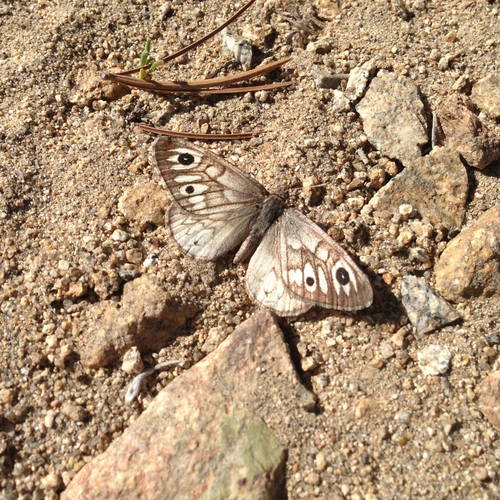
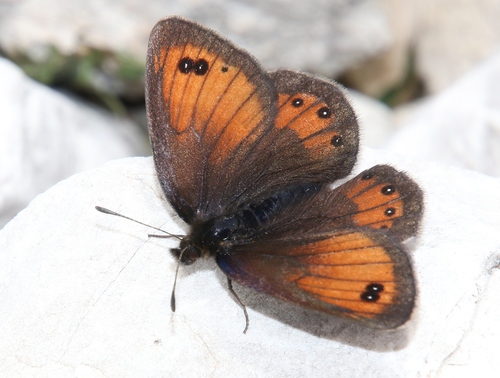
This species, Erebia gorge Esper, 1800 (also known as E. gorge Esp. (= aethiops minor Esp.)), is described from Seitz as follows. Its wings are somewhat narrower and less rounded than those of Erebia gorgone; the hindwing is distinctly angulate, and weakly dentate in females. The russet submarginal band on the forewing is rather broad, and usually extends all the way to the hindmargin. Within the band, there are 2 pupillated ocelli near the costa that are positioned somewhat obliquely relative to one another, and are joined together in females. In females (more rarely males), a small third ocellus, or a black dot in its place, sometimes occurs toward the hindmargin. The band on the hindwing is narrower, and holds 3–4 white-centred ocelli. The underside of the forewing is russet-brown, with the fore and distal margins black-brown, sometimes lightly dusted with whitish grey. The underside of the hindwing is black-brown, marbled with white-grey; the distal band is more or less light in colour, and sometimes holds 3 black eye-dots that only rarely have white centres. Females are barely different from males, only being lighter in overall colour; the underside of the hindwing is grey, dusted with brown, with a dark middle band that is dentate along its distal edge. The species is widely distributed in the higher Alps, but only occurs from the tree-line upwards. ab. erynis Esp. is a rarely occurring aberration where the ocelli are either entirely absent or only vestigial. This aberration is found in the southern Central and Eastern Alps, and in the Abruzzi. ab. triopes Spr. occurs as individual specimens alongside the nymotypical form; it is more common in the Eastern Alps, and is the dominant form at the road of the Stilfser Joch, where the name-typical form is only rarely found. In this aberration, the distal band of the forewing regularly has 3 large white-centred ocelli that are usually merged. Toward the hindmargin (though not always), 2 additional smaller ocelli are shifted toward the distal margin, and these are visible on the underside as well. The hindwing usually has 4 brightly white-centred ocelli that are somewhat smaller on the underside. gigantea Oberth. is a very large form of the species, and is otherwise barely different from the originally described form. It comes from the high mountains of Spain. E. gorge is an active butterfly that flies fairly quickly in sunshine, even in the cold air of the high altitudes where it lives. It prefers to settle with its wings half open on sun-warmed boulders. It is somewhat shyer than most other Erebia species, but does not take flight easily. However, specimens chased by collectors are often blown away by strong mountain breezes, carried downhill, and then slowly return on the lee side toward the mountain summit. Sometimes they are blown onto snow, where they often remain lying for a long time. It is abundant within its flight range, but nothing is known about its early life stages.