About Erebia epistygne Hübner, 1816
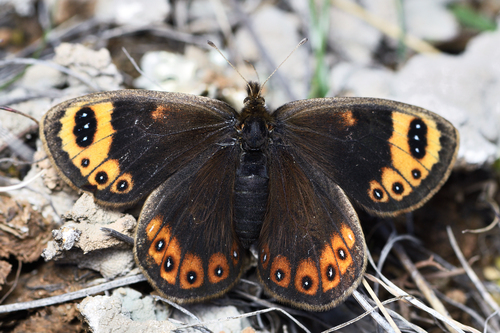
Scientific name: Erebia epistygne Hübner, 1816. This description is adapted from Seitz's treatment of the species. The upper side of the wings is coffee-brown, with the costal margin dusted with grey. The forewing usually has a diffuse yellow spot in the cell, plus a broad light ochreous submarginal band that narrows toward the posterior, and is distinctly divided by veins. The band holds 5 to 6 black ocelli with white centers: 3 near the apex are larger and united, while 3 positioned further back are smaller, with only minute white pupils. The submarginal band of the hindwing is made of 4 to 5 oval russet-red spots, each with a small white-centered ocellus. The underside of the forewing is russet-red, with the distal band somewhat lighter and crossed by brown veins; the costal margin, distal margin, and apex are grey, marked with brownish scattered particles. The underside of the hindwing is grey-brown, dusted with both grey and dark brown. Its middle band is darker than the basal and distal areas, has a crenate distal edge, and ocelli are represented in the distal area as black dots. Females do not differ essentially from males on the wing upperside, but their ground color is somewhat lighter, and the spots on the distal band of the hindwing are reddish yellow rather than russet-red, and the ocelli on these spots have larger, brighter pupils. The underside of the female hindwing is white-grey, dusted with brown; the middle band is strongly prominent, edged with white along its distal edge, and the veins crossing this band are white-grey. Specimens collected from South Spain have noticeably brighter markings: the forewing submarginal band is broader, extends to the hindmargin with nearly even width, and is light whitish yellow instead of ochreous. No other markings differ from other populations of the species. This butterfly occurs in South France, the Basses Alpes, and Central and South Spain. It can be seen in flight from the beginning of March through the end of April, with records of adults on wing extending into May. The larval host plant of this species is the grass Festuca ovina, which belongs to the family Poaceae. Erebia epistygne has also been reported feeding on other Festuca and Poa species. This species is classified as vulnerable, due to severe habitat loss.