About Erebia embla Thunberg, 1791
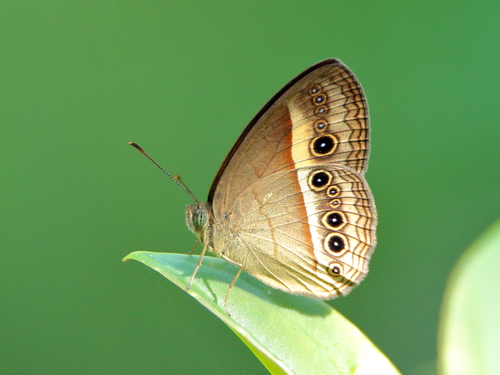
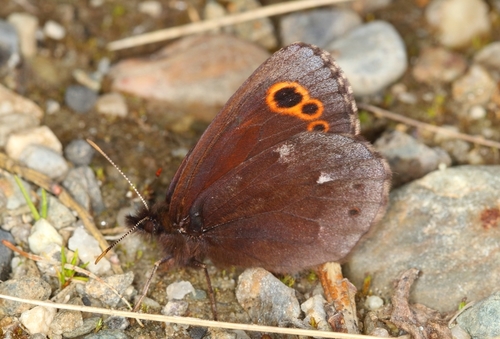
Erebia embla, first described by Thunberg in 1791, is also known under the synonym Erebia dioxippe Hbn. The typical (nymotypical) form of the species, as detailed in Seitz's description, has dark grey-brown coloration on the upper side of its wings. Its hindwing has weakly dentate edges, and its fringes are chequered brown and grey. The forewing holds 3 black eye-spots surrounded by brown-yellow rings: the anterior eye-spot is the largest, and usually has 2 white pupils, while the 2 posterior eye-spots are shifted toward the distal end of the wing, are small and black, and have no pupils. The hindwing usually has 3 to 4 black ocelli that are bordered with brown-yellow, lack pupils, and are sometimes absent entirely. The underside of the forewing is somewhat darker than the upper side; the apex and a section of the distal margin are dusted with ashy grey. The ocelli on the underside are not brown-yellow, but are light with an ochre-yellow ring, and are more prominent than they are on the upper wing. The underside of the hindwing is densely dusted with white-grey, and features a more or less prominent brown median band that is slightly dentate along its distal edge. Outside of this band, there is sometimes a larger, somewhat diffuse grey costal spot, and there is usually a small white spot at the center. Before the distal margin, there are some black dots, which are narrowly edged with yellow in some places. The nymotypical form of Erebia embla is found in Scandinavia, North Russia, and Siberia. The aberrant form ab. succulenta Alph. is lighter on the upper side than nymotypical embla, and has more numerous and larger black eye-spots that are additionally broadly ringed with brown-yellow. This form is found in Kamchatka and Mongolia; occasional specimens also occur among populations of the nymotypical embla form in Europe. The unicolor Spuler form occurs in northern Fennoscandia; it is uniformly black-brown, and all ocelli are absent from the forewing except the upper two, which are either faintly edged with red or have no colored edging at all. Nothing is known about the larval stage of Erebia embla. The typical embla form flies on northern moors; according to Elwes, the succulenta form flies in woods, and the species does not appear to be abundant anywhere it occurs. Three subspecies are currently recognized: E. e. embla Becklin, 1791, found from Fennoscandia to East Siberia; E. e. dissimulata Warren, 1931, found in the Altai and Sayan Mountains; and E. e. succulenta Alphéraky, 1897, found in the Russian Far East.