About Erebia disa Thunberg, 1791
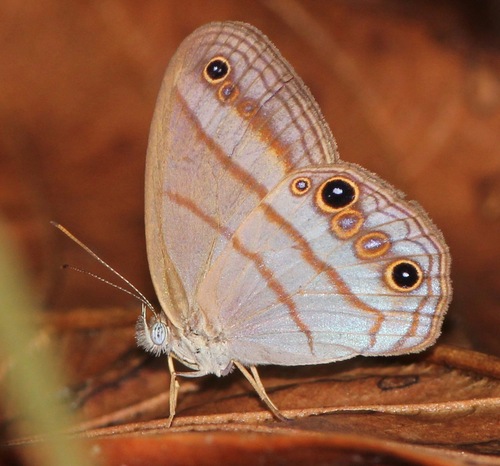
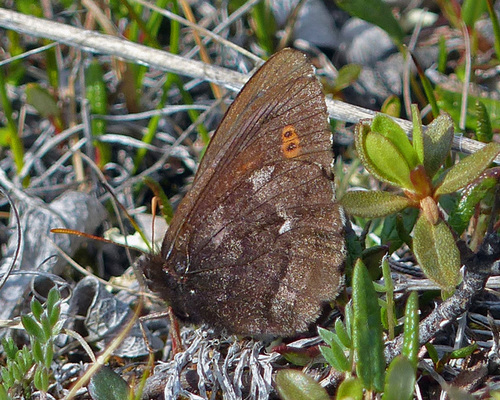
Erebia disa Thunberg, 1791, commonly called the Arctic ringlet, has the following physical description. The upperside of its wings is dark brown, with a fine black and white hashed line running along the hind margins. The forewing has a red or orange strip positioned fairly close to the edge; this strip holds four black blotches, each with a white-centred eyespot. The hindwing is plain dark brown on the upperside. The underside of the forewing matches the appearance of the forewing upperside. The underside of the hindwing is greyish brown, with a broad dark brown lateral band and a black and white hashed margin. The total wingspan of this species ranges from 40 to 50 mm (1.6 to 2.0 in). This butterfly can be confused with two related species: the Lapland ringlet (Erebia embla) and the Arran brown (Erebia ligea). Both of these similar species can be distinguished by the white markings they have on their hindwing undersides, which Erebia disa lacks. This species has a Holarctic distribution. It occurs in Arctic Europe, Arctic European Russia's Kanin Peninsula, Sajan, Irkutsk, Yakutsk, Yablonoi, and Arctic North America. Its typical native habitat consists of bogs and damp forests. In its life cycle, the larval food plants are multiple species from three groups: grasses in the family Poaceae, cottongrasses in the genus Eriophorum, and sedges in the genus Carex. The larva overwinters twice in its caterpillar stage, and adult butterflies generally fly in July.