About Erebia aethiops Esper, 1777
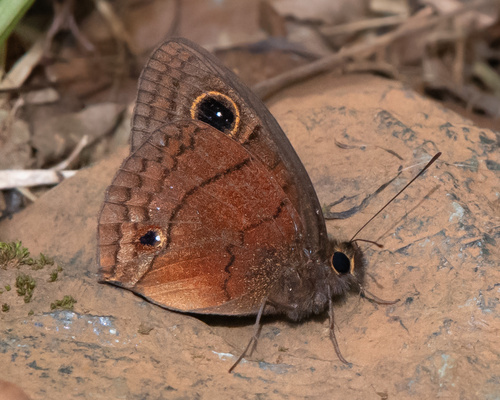
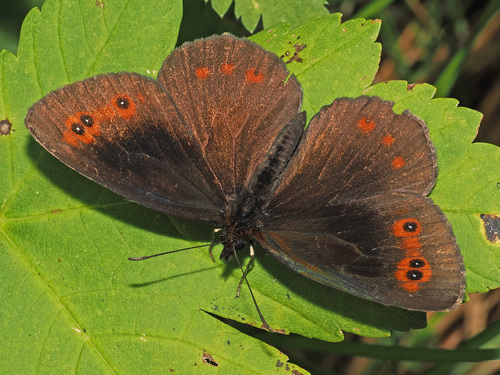
Erebia aethiops Esper, 1777 has a wingspan of 42–46 mm. Its antennae are clavate, meaning club shaped. The background colour of the wings ranges from dark brown to black brown. The wings feature reddish-yellow bands, black eyespots with white pupils, and greyish wing fringes that are weakly chequered in females. On the forewing there are three or four eyespots, usually two apical plus a third separate from them, while on the hindwings there are four or five. The underside of the hindwings shows whitish or cream banding, and the species has slightly marked sexual dimorphism. In Scotland, the subspecies caledonia has a narrower reddish-yellow band and never has more than three small eyespots, with three black spots present on each hindwing. The egg of Erebia aethiops is oval shaped, with 20 to 28 longitudinal ribs. A mature caterpillar is yellow brown, with a brown head. Pupae are yellow brown, relatively short and compact, and reach a length of 12.5–124.5 millimetres (0.49–4.90 in). This species is quite similar to Erebia ligea, but the fringes along the edges of the upper side of the wings are a lighter grey, while the fringes on E. ligea are white. A short description of both species was published by Wheeler (1903). Erebia aethiops is widespread across the Palearctic realm. Its range covers most of Europe, the Alps, the Apennines, the Balkans, Asia Minor, the Urals, and the Caucasus. In England, established colonies occur at Arnside Knott and Smardale Gill, both located in Cumbria. The species is found across most of northern Scotland, and in western areas of southern Scotland. In Europe and Russia, these butterflies favour the edges of pine forests and tall damp grassland in hills and mountains up to 2400 m in elevation.