About Epirrhoe alternata (Müller, 1764)
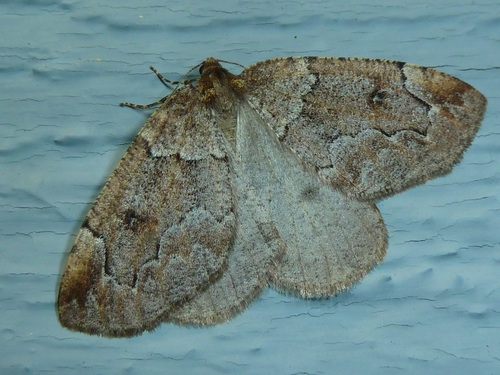
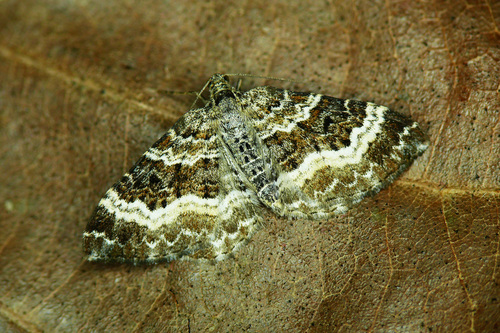
Epirrhoe alternata, commonly known as the common carpet or white-banded toothed carpet, is a moth species belonging to the family Geometridae. This species was first described by Otto Friedrich Müller in 1764. It is distributed across the entire Palearctic region and the Near East. In North America, its range extends across the northern tier of the United States, as well as every province and territory of Canada. This moth has a wingspan of 27 to 30 mm. Its forewings range in colour from grey to black, marked with white bands that create a striped appearance. The base of the forewings is patterned grey. After a narrow light band comes a wide brown-patterned band, followed by an almost pure light band. Beyond this band, the outer edge of the wing is again patterned in dark brown and grey. The outer dark band is intersected along its entire length by a grey line. The hindwings are a paler grey and also marked with white bands. Northern races of the species are typically paler overall. The width of the central band varies; it is often narrower below the middle, and sometimes completely split at this point. In the aberration degenerata first described by Haworth, both sections of the band are much narrower. Brownish-grey individuals from the Isle of Lewis are classified as the variety obscurata described by South. There are also intermediate forms that lead to a variant where the entire central third of the forewings is whitish, with the usual cross lines appearing dingy grey, and small grey clouds of the same colour surrounding the black discal spot. The species produces one or two generations per year, and adults can be seen between May and September, with this flight season referring specifically to the British Isles; flight times may differ in other parts of the species' range. Adult common carpet moths fly at night and are attracted to light. The larva is typically brown or green, and is highly variable in its markings. It feeds on bedstraw plants. The species overwinters in the pupal stage.