About Epipremnum aureum (Linden & André) G.S.Bunting
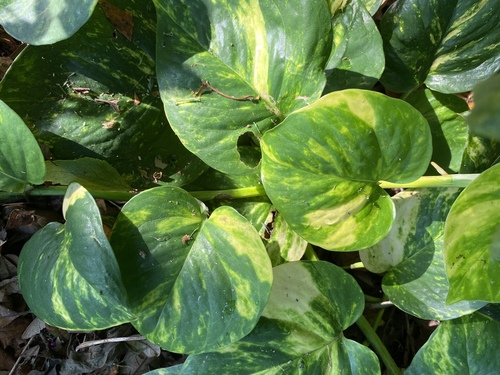
Epipremnum aureum is an evergreen vine that can reach up to 20 meters (66 feet) in height, with stems growing up to 4 centimeters (2 inches) in diameter. It climbs by producing aerial roots that adhere to surrounding surfaces. Its leaves are arranged alternately; they are heart-shaped and fully intact on juvenile plants, but become irregularly pinnatifid on mature plants. Mature leaves can grow up to 100 centimeters (39 inches) long and 45 centimeters (18 inches) wide, while juvenile leaves are much smaller, typically under 20 centimeters (8 inches) in length. This species produces flowers inside a spathe that can reach up to 23 centimeters (9 inches) long. When climbing trees, the plant grows trailing stems that root when they touch the ground and continue to grow along its surface. Leaves on these trailing stems reach a maximum length of 10 centimeters (4 inches), and these are the leaves most commonly seen on the plant when it is grown as a potted houseplant. Originally, this species was endemic only to the island of Mo'orea in the Society Islands. It is now naturalized in many tropical countries, with recorded introduced ranges including Bangladesh, India, Myanmar, Thailand, Vietnam, Hainan, Hong Kong, Taiwan, Japan, peninsular Malaysia, Sabah, Sarawak, Singapore, Java, the Maluku Islands, Nusa Tenggara, Sulawesi, Sumatra, the Philippines, the Solomon Islands, Vanuatu, New Caledonia, New Guinea, Queensland, the Marshall Islands, Hawaii, Palau, Fiji, Tonga, the Cook Islands, and Western Samoa. According to the ASPCA, Epipremnum aureum is toxic to cats and dogs due to the presence of insoluble raphides. Owners should take precautions to prevent pet consumption. If consumed by pets, symptoms may include oral irritation, vomiting, and difficulty swallowing. Because it contains calcium oxalate, it is also mildly toxic to humans. Consumption of E. aureum can cause side effects including atopic dermatitis (eczema), and burning or swelling inside and around the mouth. Extended contact with the plant can also cause general skin irritation or contact dermatitis. In temperate regions, Epipremnum aureum is a popular houseplant, and many cultivars have been selected for their variegated leaves with white, yellow, or light green markings. It is commonly used for decorative displays in shopping centers, offices, and other public spaces, largely because it requires minimal care and has attractive foliage. In tropical countries, it grows in many parks and gardens, and often grows wild naturally. As an indoor plant given adequate climbing support such as a trellis or moss pole, it can reach over 2 meters (2 yards) in height, but it rarely produces mature-sized leaves indoors. It grows best with indirect light; it can tolerate high luminosity, but long periods of direct sunlight will burn its leaves. It thrives in temperatures between 17 and 30 °C (63 and 86 °F). Generally, it only needs watering when the soil feels dry to the touch, which is typically once every one to two weeks. It should be fertilized every 2 to 3 months during its growing season, and at a reduced frequency for the rest of the year. It should be repotted at least every 1 to 2 years, or sooner if it becomes root-bound. This is a very robust plant that can survive poor growing conditions, and it grows rapidly when grown in hydroponic culture. It can be easily propagated from cuttings, but cuttings may carry a range of plant diseases including Erwinia leaf spot, Pythium root rot, Rhizoctonia root rot (Rhizoctonia foot rot), Pseudomonas leaf spot, Southern blight, and Xanthomonas blight. In controlled conditions such as a sealed room, this plant can remove indoor air pollutants including formaldehyde, trichloroethene, toluene, xylene, and benzene. One study found that this pollutant removal effect decreases as the molecular weight of the pollutant increases. It is sometimes used in aquarium setups, placed on top of the aquarium with its roots growing down into the water. This arrangement benefits both the plant and the aquarium, as the plant absorbs nitrates from the water to use for growth.