About Epipactis palustris (L.) Crantz
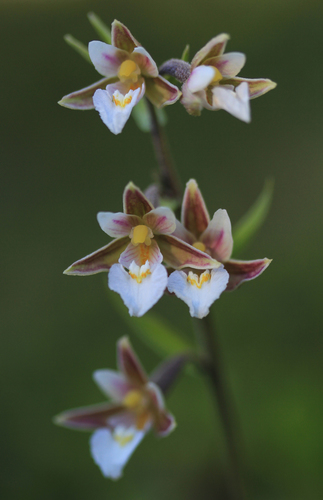
Epipactis palustris (L.) Crantz is a perennial herbaceous orchid. It persists via an underground horizontal rhizome, which produces new roots and stems each growing year. Its above-ground aerial stem grows upright to 60 cm tall, has a cylindrical cross-section, and bears up to ten erect leaves. The leaves are up to 12 cm long and up to 4 cm wide, with parallel venation. The base of the aerial stem is smooth (glabrous) and surrounded by pink scales, while the upper stem is pubescent (hairy) and slightly reddened. Its flowers measure 17 mm across and are arranged in a one-sided raceme. In the typical form, sepals are deep pink or purplish-red, and upper petals are shorter and paler. The labellum is at least as long as the sepals, and is white with red or yellow spots in its center. A variant lacking most of the typical form's reddish coloration is named E. palustris var. ochroleuca. After flowering, it produces a many-ribbed capsule fruit that holds a large number of extremely small seeds. This species is distributed across Europe (including the United Kingdom and Mediterranean countries), Turkey, northern Iraq, the Caucasus, northern Iran, West Siberia, East Siberia, and Central Asia, and occurs within the Sarmatic mixed forests ecoregion. It grows most commonly in humid woodland, humid grassland, marshes, dune slacks, and bogs. It favors calcareous, basic pH substrates with low nutrient availability and medium moisture levels. Every flower of E. palustris contains both male and female reproductive organs. Flowers produce nectar, and are pollinated by wasps, bees, and Diptera. Like all orchids, E. palustris forms a symbiotic relationship with soil fungi, which helps the plant access more soil nutrients. Compared to other species in the Epipactis genus, E. palustris has specialized fungal partners: it associates mainly with fungal species in the order Helotiales, and also associates much less frequently with Sebacina, Tulasnella, Thelephora, and Ceratobasidium, in descending order of occurrence frequency.