About Epipactis dunensis (T.Stephenson & T.A.Stephenson) Godfery
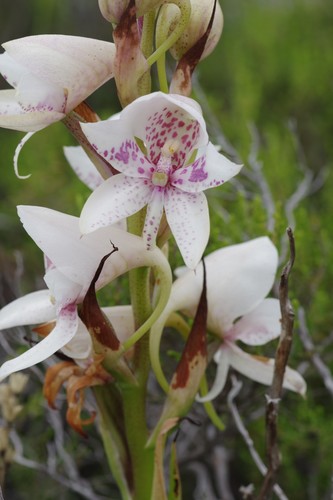
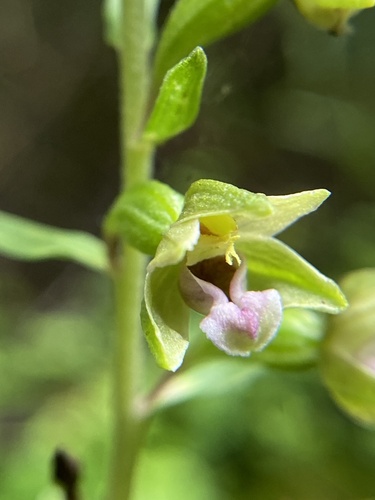
Epipactis dunensis, commonly known as dune helleborine, is a species of orchid in the family Orchidaceae, and it is endemic to Great Britain and Ireland. It usually grows between 20 and 50 cm (7.9 to 19.7 in) tall, and the upper half of its flowering stalk is hairy. This species has a long, fleshy rootstock, and three to ten yellowish green, oval to lance-shaped leaves arranged in opposite rows along the flowering stem. The flowering stem can bear up to 35 flowers. Of its floral structures, the three sepals are greenish, the two petals are paler in color. The lower part of the labellum, called the hypochile, is boat-shaped, dark chocolate brown, and has a transparent, whitish rim. The upper part of the labellum, the epichile, is heart-shaped with a pointed tip. Flowering takes place from late June to mid-August, and the flowers are mainly self-pollinated. The fruit produced is a capsule that holds light, microscopic seeds that are dispersed by wind. This species was first formally described in 1918 by Thomas Stephenson and Thomas Alan Stephenson, who published it under the name Helleborine viridiflora f. dunensis in the Journal of Botany, British and Foreign. In 1926, Masters John Godfery elevated this form to full species status as Epipactis dunensis. Dune helleborine grows in willow scrub near dune troughs in England, Scotland, and along the east coast of the Irish Republic. Some authorities recognize a variant called Tyne helleborine that grows in woodland in northern England and southern Scotland.