About Epinotia nisella (Clerck, 1759)
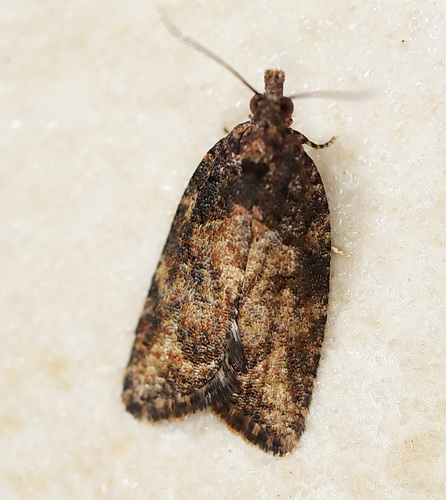
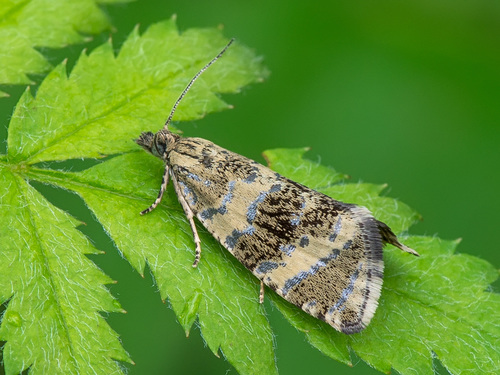
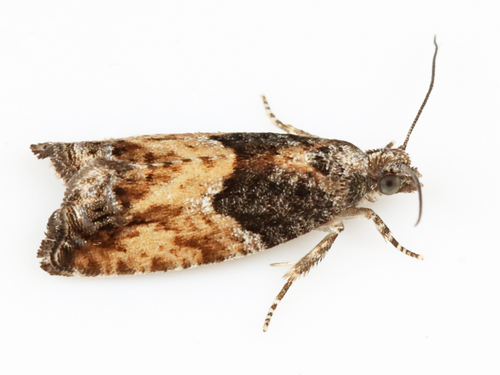
Epinotia nisella is a moth species belonging to the family Tortricidae. It was first formally described by Carl Alexander Clerck in 1759. This species occurs across the Palearctic realm, Europe, and North America. In Europe, it is present in most regions, excluding Iceland, Portugal, Ukraine, and the central portion of the Balkan Peninsula. Its range extends east through the Near East to the eastern part of the Palearctic realm. In North America, the species can be found across Canada from Newfoundland to British Columbia, and in the United States it has been recorded in Massachusetts and Minnesota. The wingspan of adult Epinotia nisella measures approximately 12 to 17 mm. The forewings are primarily grey, with variable amounts of white mixing, a slight rusty reddish tinge, and irregular streaks of blackish-grey. The basal patch of the forewing is darker than the surrounding area; its outer edge is darker blackish and forms a sharp acute angle in the middle. A flattened, triangular rusty reddish or red-brown dorsal blotch is often present just distal to this basal patch. The central fascia of the forewing is slender, irregular, and slightly darker than the surrounding wing tissue. The edges of the wing's ocellus, and sometimes a small line above the ocellus, are leaden metallic in color. In some individuals, the entire forewing is suffused with a rusty reddish tone, with the exception of the basal and terminal patches. The outer margin of the forewing is sinuate, or wavy. The hindwings are light brownish-grey, becoming darker brownish-grey toward the outer edge. Full-grown larvae are pale green with a dark brown head. Adult moths are active on the wing during July and August. During the day, adults rest on foliage or among lichen growing on the trunks of their larval host trees. When disturbed, they fly in an erratic path to a new resting spot. In the evening, adults will come to artificial light sources.