About Epinotia nanana (Treitschke, 1835)
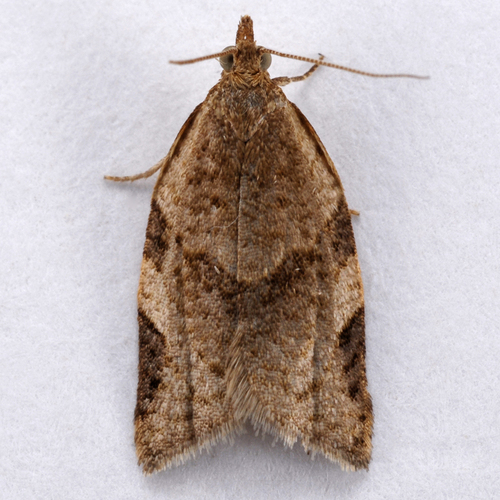
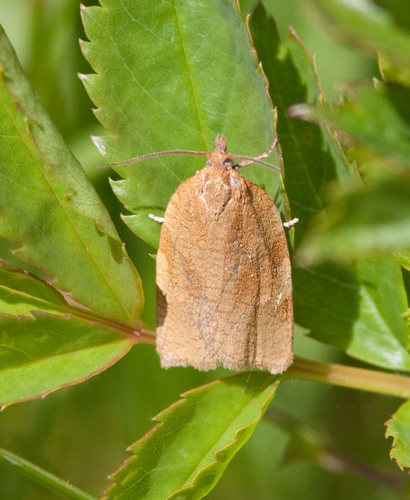
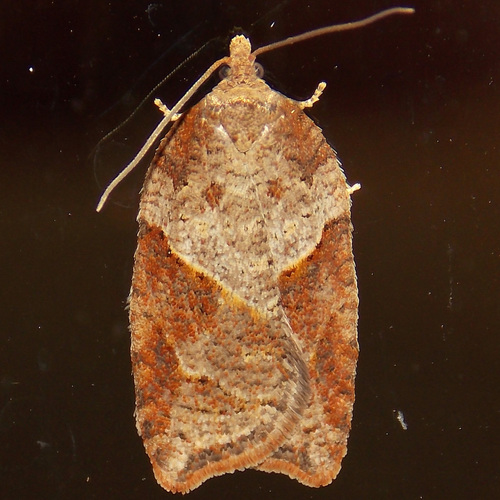
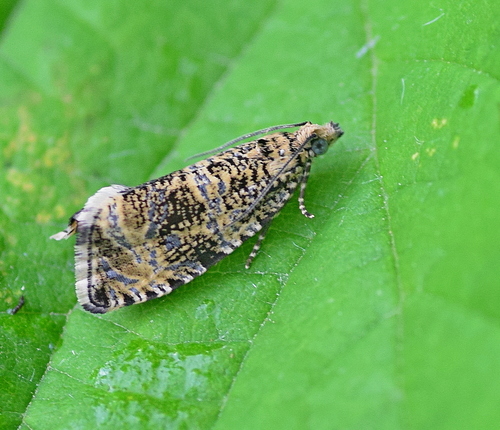
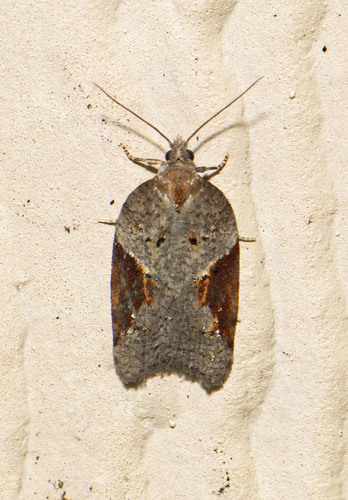
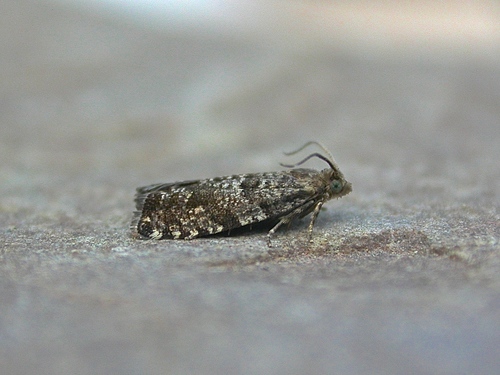
Epinotia nanana, commonly known as the European spruce needleminer, is a moth species belonging to the family Tortricidae. Its natural distribution ranges from northern and central Europe east to Russia and Mongolia. It has also been recorded in Canada, specifically in British Columbia, Ontario, and Quebec, and in the United States from Maine to Michigan and Ohio. The wingspan of adult Epinotia nanana measures 9–11 mm. The head is pale brownish-ochreous, and the face is whitish. The forewings have a gently arched costa, with a ground colour of lighter or darker fuscous sprinkled with white. The costa is marked with alternating dark fuscous and white streaks. The edge of the basal patch is obtusely angled below the middle; the central fascia has a posterior median projection, and there is a transverse streak before the apex. All these markings are dark fuscous. The hindwings are a rather dark fuscous. Adults are active on wing from June to August. Females usually lay eggs singly on previous year's needles, though they occasionally lay eggs in clusters. Eggs hatch soon after being laid. Larvae feed inside host plant needles through summer and fall, then overwinter inside mined needles once they are nearly fully grown. Nearly full-grown larvae resume feeding on adjacent new needles in early spring. A single larva will mine between 6 and 10 needles total, and secures the mined needles to the host twig with silk. When fully grown, larvae reach approximately 9 mm in length. The larva is brown, with a black head and black second thoracic plate. Full-grown larvae pupate in a silken cocoon in soil litter, or occasionally directly on the tree, during May or June. Adults emerge from the pupae after four weeks. This species' larvae feed on most spruce species, with a preference for Norway spruce; recorded host species include Picea abies, Picea excelsa, Picea pungens and Picea sitchensis, and larvae feed by mining the needles of their host plants.