About Epinephelus ongus (Bloch, 1790)
Body Length-to-Depth Ratio
Epinephelus ongus (Bloch, 1790) has a body whose standard length is 2.7 to 3.2 times its depth.
Head Morphology
The dorsal profile of the head is moderately convex, and the area between the eyes is flat. The preopercle is rounded, and the serrations along its edge are mostly covered by skin. The upper edge of the gill cover is distinctly convex.
Fin Ray Counts
The dorsal fin has 11 spines and 14 to 16 soft rays, while the anal fin has 3 spines and 8 soft rays.
Caudal Fin Shape
The caudal fin ranges from convex to slightly rounded in shape.
Adult Body Coloration
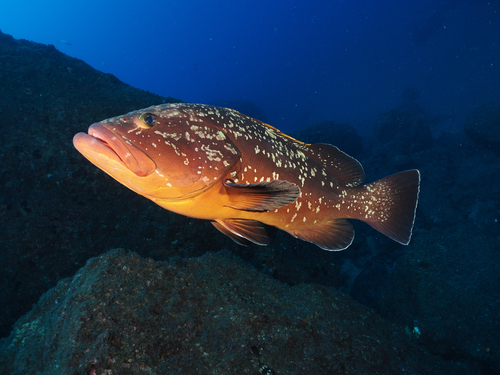
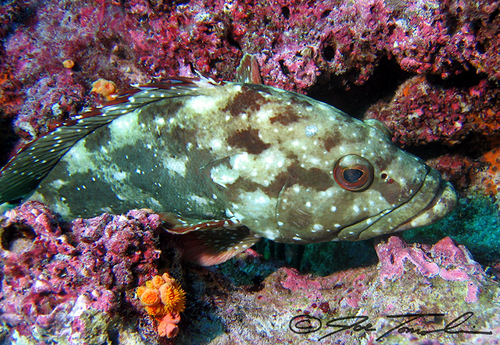
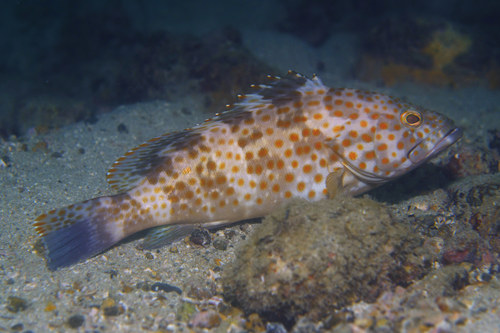
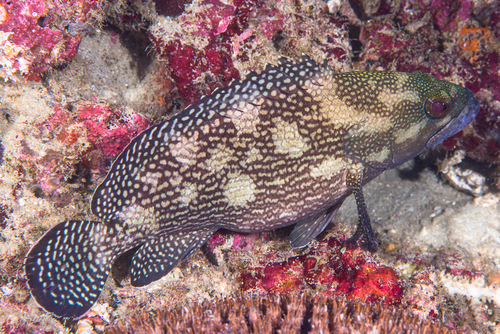
The overall body color of this species is brown, marked with large white blotches and many smaller pale spots across the head, body, and fins; in larger individuals, these markings elongate and form streaks. The median fins have a dark submarginal band.
Juvenile Coloration
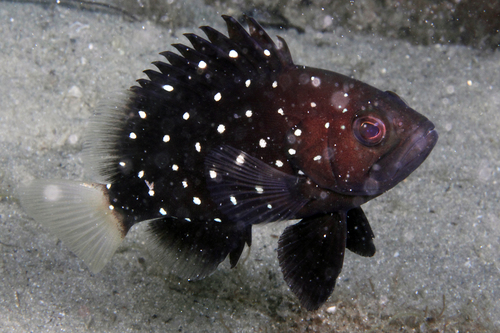
Juveniles are dark brown, with a pattern of white spots covering their bodies and fins. The spots often form wavy lines, and there is a faint dark maxillary streak.
Maximum Length
This species reaches a maximum published total length of 40 centimetres (16 in).
Distribution Range Overview
Epinephelus ongus has a wide distribution across the Indo-Pacific.
West Indo-Pacific Distribution
It occurs along the east African coast from Somalia to South Africa, and is also found in Madagascar, the Seychelles, the Maldives, southern India, Sri Lanka, and along the coasts of Thailand and Malaysia, extending east into the Pacific Ocean as far as New Caledonia and Tonga.
North and South Distribution Limits
Its range extends north to the Ryukyu Islands and Ogasawara Islands in southern Japan, and south to Australia.
Australian Distribution
In Australia, it is found around offshore reefs of Western Australia, off Arnhem Land in the Northern Territory, and on the Great Barrier Reef off Queensland.
Habitat and Depth Range
Epinephelus ongus inhabits inner coastal reefs, lagoon reefs, and brackish waters, where it occurs in ledges and caves at depths between 5 and 25 metres (16 and 82 ft).
Depth Segregation by Age
Adults typically live in deeper water than juveniles.
Diet
This species mainly preys on crustaceans and small fishes.
Coral Association
Off the coast of Okinawa, it is associated with branching corals of the genus Acropora.
Reproductive Biology
It is thought to be a protogynous hermaphrodite, with half of all individuals changing sex when they reach a total length of 27.2 centimetres (10.7 in) and an age of 7 years.
Spawning Aggregations
The species has been recorded forming spawning aggregations; off Okinawa, these aggregations form over a sand and rubble seabed near a reef pass, and fish travel an average of 5 to 6 kilometres (3.1 to 3.7 miles) to reach this spawning site.
Parasite Overview
Like other groupers, this species typically hosts a number of parasites, but little is known about its full parasitofauna.
Gill Parasites
In New Caledonia, a specific diplectanid monogenean, Pseudorhabdosynochus quadratus, is found on its gills.
Endoparasites
Other confirmed endoparasites of Epinephelus ongus are the digeneans Lepidapedoides angustus and Pearsonellum corventum.