About Epilobium canum (Greene) P.H.Raven
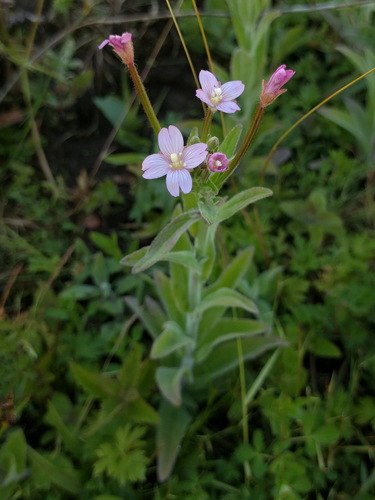
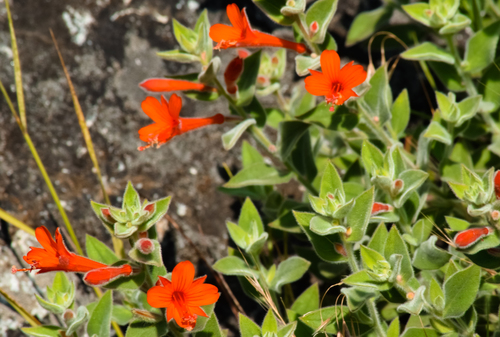
Epilobium canum (Greene) P.H.Raven is a subshrub that grows up to 60 centimetres (24 inches) tall. Native populations of this species show considerable variation in appearance and growth habit. Its small leaves can be arranged opposite or alternate along stems, shaped either lance-like or ovate, with short stalks or no stalks at all, and range in color from green to nearly white. The overall plant form may be matting or mounding, and plants commonly spread through rhizomes. Terminal racemes hold tubular or funnel-shaped flowers, which are mostly reddish, ranging in shade from fuchsia to pink to red-orange. The broad range of variation within the species has led to the description of many subspecies, most of which are no longer recognised as distinct because of extensive intergradation between forms. Three subspecies are still recognised: Epilobium canum subsp. canum (which includes the previously recognised subspecies angustifolia and microphylla), Epilobium canum subsp. garrettii, and Epilobium canum subsp. latifolium.
For cultivation, matching the species' native habitat conditions, Epilobium canum prefers to be grown in well-drained soil in full sun with protection from wind, and requires very little watering. Epilobium canum subsp. canum is hardy to USDA zone 8a. The species (or its cultivars) has received the Royal Horticultural Society's Award of Garden Merit under the older name Zauschneria californica. A small number of hybrid cultivars have been introduced by various growers, in some cases developed from isolated native populations, such as those found on Santa Cruz Island off the California coast.