About Epigaea repens L.
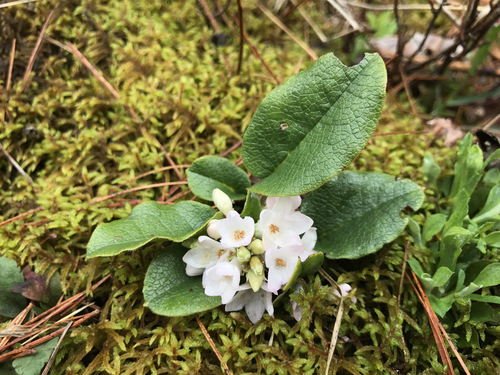
Epigaea repens L. is a slow-growing shrub with a growth habit that ranges from prostrate to sprawling. It favors moist, shady environments and acidic, humus-rich soil, and is a common component of the heath complex in oak-heath forests. Its stems are woody, and leafy twigs are covered in rust-colored hairs. The plant has alternate, evergreen, ovate leaves (oval-shaped with rounded bases) that are smooth on the upper surface and more or less hairy on the underside; leaves grow on short petioles that are covered in rust-colored hairs. Its flowers are pentamerous, pale pink to nearly white, and very fragrant. When fully open, flowers are around 0.5 inches (1.3 cm) across, and grow in clusters at the ends of branches. The calyx is made up of five dry, overlapping sepals. The corolla is salverform, with a slender hairy tube that opens into five equal lobes. Each flower has five stamens. The gynoecium has a single pistil with a columnar style and a five-lobed stigma. The genus name Epigaea, which means "upon the earth", refers to this species' sprawling growth habit. Native American groups have various traditional uses for this plant. The Algonquin use an infusion made from its leaves to treat kidney disorders. The Cherokee use a decoction of the plant to induce vomiting for abdominal pain, and give an infusion of the plant to children to treat diarrhea. The Cherokee also use an infusion for kidney issues and "chest ailment", and take a compound infusion to treat indigestion. The Iroquois use a compound preparation to ease labor pains during childbirth, use a compound decoction to treat rheumatism, take a decoction of the leaves for indigestion, and drink a decoction of the whole plant, or the roots, stalks, and leaves, to treat kidney issues. The Forest Potawatomi consider this plant their tribal flower, and believe it originated directly from their divinity.