About Epidendrum denticulatum Barb.Rodr.
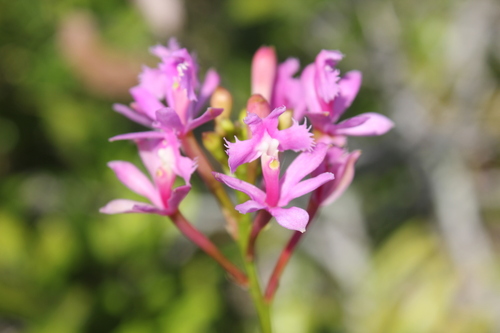
Epidendrum denticulatum Barb.Rodr. is a sympodial reed-stemmed Epidendrum with a pseudomonopodial growth habit. Individual stems grow up to 4 mm in diameter, growing continuously at the tip for some time before producing a bloom spike. Flowers emerge from the top of the stem, halting the stem’s upward growth, and new stems grow from buds at the base of older stems, making the plant sympodial like other members of the subtribe Laeliinae. Low lighting encourages the formation of numerous keikis, which produce a tangled mass of shoots and roots high on the plant, while full sunlight leads most new growths to start near the base of old growths, resulting in a shorter, tidier plant. This species has long, thin roots that are 3 mm or less thick, covered in spongy velamen, and extend through the air into the ground. Its alternate, coriaceous leaves grow up to 9 cm long and 2 cm wide. The inflorescence is a terminal raceme that fills a globular space measuring more than 30 cm, and can hold up to one hundred flowers, with 10 to 30 open at the same time. A single inflorescence can remain in bloom for up to one year. Flowers may be white, cream, yellow, or orange, but are most commonly lavender; each flower measures approximately 2 cm in diameter. The two petals and three sepals are similar in shape, oval, measuring about 11 mm long by 5 mm wide, with an angle of close to 60° between adjacent perianth segments. Like all Epidendrum flowers, the lip is adnate to the column all the way to its end. Like other members of section E. sect. Schistochila, the lip is divided into three lobes. This species is named for the tooth-like serrated margins of its three labial lobes. The chromosome number of Epidendrum denticulatum is 2n = 40.
To distinguish this species from close relatives, the most noticeable difference between E. denticulatum and E. secundum is the callus: E. denticulatum has two small calli near the column, with a long keel starting between them, while E. secundum has a single much larger callus positioned in front of the column. To help identify herbarium specimens, Pinheiro and Barros (2007) conducted a statistical examination of cultivated flowers growing in São Paulo, Brazil. They found that E. denticulatum has a column length of 7–8 mm, a labellum width of 11.7–13.4 mm, a lateral lobe length of 4.9–5.7 mm (measured from the edge of the callus to the end of the lateral lobe), and a central lobe length of 2.2–3.2 mm (measured from the point where the lateral and central lobes meet). By contrast, E. secundum has a column length of 4.7–6.2 mm, a lip width of 8.6–10.2 mm, a lateral lobe length of 2.5–3.8 mm, and a central lobe length of 3–4 mm. According to Almeida & Figueiredo (2003), E. denticulatum produces nectar on the petioles of buds, flowers, and fruits, but does not produce nectar on the flowers themselves. According to Pansarin & Amaral (2008), E. secundum has a nectary at the back of the tube formed by the flower lip and column. E. denticulatum can also be distinguished from the very similar resupinate-flowered E. ibaguense and E. radicans by its non-resupinate flowers.
Epidendrum denticulatum grows in the tropical dry forests of the Serra do Mar in Brazil, ranging from the coastal states of Rio Grande do Sul to Pernambuco, and also occurs in the forests of Minas Gerais, at altitudes between 0.5 km and 1.4 km. This plant grows both terrestrially and epiphytically. It is most commonly found among low bushes and at road edges, and occasionally forms large tussocks that measure more than 5 m2. Several references claim this species grows at low altitudes near the sea shore, but these reports likely stem from confusing E. denticulatum with other members of the Schistochila Carinata subsection of Epidendrum, such as E. cinnabarinum, E. fulgens, and E. puniceoluteum.