About Epidendrum conopseum R.Br.
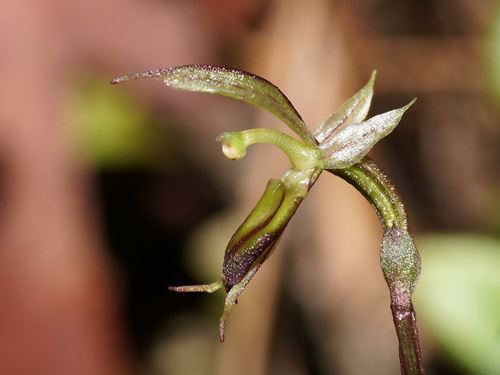
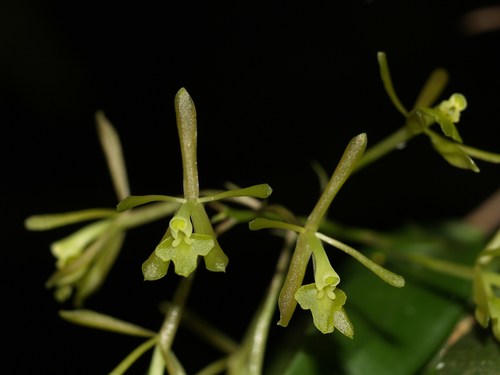
Epidendrum conopseum R.Br. has robust roots that cling to tree bark, and short, often pendulous cane-shaped stems wrapped in tubular leaf sheaths. Each stem bears two or three leathery, elliptical leaves with acute or subacute tips. The leaves are broadly elliptical, growing up to 10 cm (3.9 in) long, and are thick and nearly leathery. Flowering typically occurs from late autumn to spring, when the plant produces a terminal, racemose, erect, loose inflorescence about 16 cm long that holds a small number of flowers. A single plant produces 6 to 14 flowers, each just over 2 cm in diameter, and colored pale green to bronze. The sepals and petals are oblanceolate, and the lip is three-lobed at the apex. The diploid chromosome number of E. conopseum has been determined as 2n = 40, while the haploid chromosome number is n = 20. This species is the most northern-growing epiphytic orchid in North America. It grows wild in the southeastern United States, specifically in Alabama, Florida, Georgia, Louisiana, Mississippi, North Carolina, and South Carolina, and also in northeastern Mexico, in the states of Nuevo León, San Luis Potosí, and Tamaulipas. Epidendrum conopseum grows on the branches of evergreen and deciduous trees including Magnolia grandiflora, Quercus virginiana, Taxodium distichum, Swamp Black Gum, and American beech, at low elevations less than 100 m (330 ft) above sea level. It is often found growing in association with the fern Pleopeltis polypodioides.